

On Peter Gabriel's "Melt" and Steve Biko
Published on Feb 21, 2026
Be Sure to Wear Flowers in Your Hair
Published on Jan 19, 2026
WALK OUT TO WINTER: falling in love with—and to—Aztec Camera's High Land, Hard Rain
Published on Dec 26, 2025
First Anniversary
Published on Dec 17, 2025
More Liner Notes…
Featured Essay: A Tour of Pour House Pressing
by Joe Corey III
We talk about our love of vinyl records, but have you ever seen where vinyl records come from? I never thought I’d have a chance since the stickers on the back of new albums seem to always declare they were manufactured in distant countries. What are the chances of visiting a factory without renewing my passport? I learned a few months ago that there was a record pressing plant in Raleigh, North Carolina just down the road from me. So I made a call to see if I could visit and they invited me over for a tour.
Pour House Pressing has been creating the platters that matter for two and a half years. Lacie and Adam Lindstaedtwere already major music people in the City of Oaks with their downtown Pour House Music Hall venue that has a record store on the second level. How did the Pour House go from being a concert venue and record store into the record manufacturing business?
“Adam and I had talked about it for years, honestly,” Lacie said. “But we’ve just never had time to even think about how to. There’s no guidebooks. You have to figure this out by yourself. But COVID happened and the venue closed and the record shop closed.” The couple feared the worst, “Live music might never come back,” she feared. “It really felt like this was over.” Instead of getting too bleak about the situation, they looked for future solutions. “How are artists going to make money?” she asked. “They’re going to need merch.” Their dream of pressing records was now a call to action during the months of the lockdown. “This was the time to do it. And so we figured it out. We’re still figuring it out every day, but that’s kind of how it all came about.”
The operation currently has two different record pressing machines on the factory floor. How hard was it to track down a record pressing machine?
“The pressing machine was not as hard,” she replied. “Nowadays there are two, maybe three companies that make brand new presses. What you see down there are two new presses. We bought those directly from the manufacturer.”
There are plants that use legacy pressing machines from the ‘80s and older. It sounds like all the machines that worked during that era are currently employed. The remaining machines have been cannibalized for parts.
How does a band that’s been recording their songs digitally get the music into a vinyl groove?
“We always recommend getting your music mastered for vinyl specifically. Mastering for digital is fine, but mastering for vinyl is specific because the grooves make different sounds than a perfect digital file. A lot of times we might hear sibilants on a record that you wouldn’t hear on a digital file. (You want to have) enough headroom to make sure that the beats are there,” she said. There’s also a question of how much music to put on your record. “People don’t realize how a record is a physical piece. We recommend 20 minutes per side. Once you get over like 24 minutes, you’re just losing space. You’re going to start losing fidelity.”
The next stage is the creation of the metal stampers for pressing the vinyl into a record.
“We don’t make that in-house. What happens first is the lacquer gets cut. We work with a lacquer engineer that’s in Bristol. And they’re great. They cut the lacquer and send the lacquer to the electroplating facility (in Charlotte). They put it in a nickel based bath. They make a mother stamper and then they make copies of other stampers from that mother.” Both places are within the Southeast region along with the printer that regularly makes the album covers.
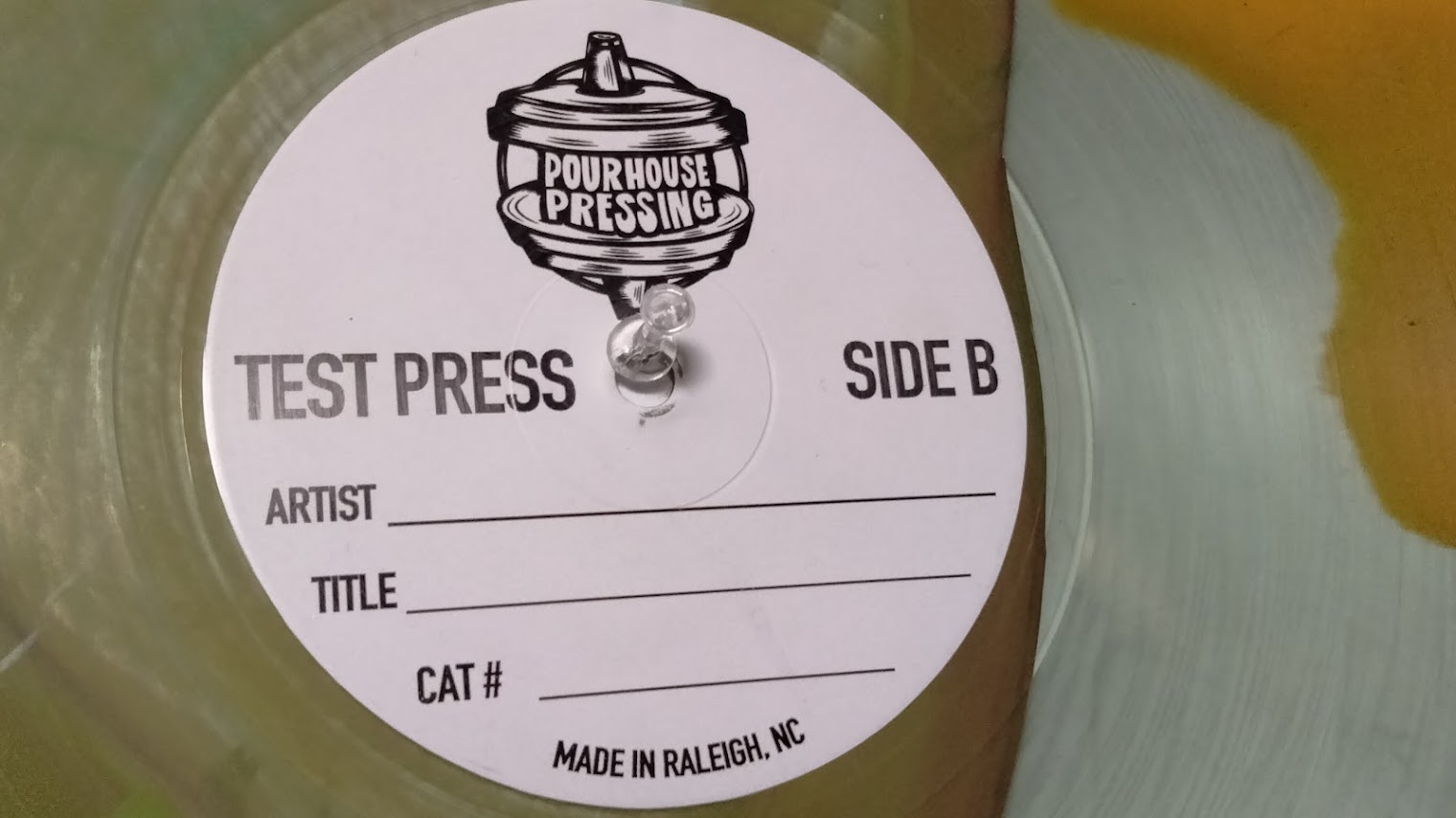
The process of making the physical media begins when the metal stampers arrive at the factory. “We start with a test press. We send that to the artist or the label. Once they give it a listen and approve the test press; we get them on the production schedule and then we do the full thing.”
The number of records they produce for a title can vary from a few hundred to several thousand. They had just finished pressing 10,000 albums for a band. It seems like most bands want a few thousand records pressed at a time. “It’s not millions. We’re a small plant. There’s pressing plants in the U.S. that have 50 machines that are built out for like those 100,000 to million runs for the Taylor Swifts of the world. We’re not built for that yet.”
The more records a band wants made, the more pressing plates the process requires. “You can get close to a thousand records pressed with one set of plates. After that the plate starts to deteriorate and you just need a new set of plates,” she informed me.
How many pounds of vinyl is required to produce 1,000 records? Lacie replied that it takes 550 pounds of PVC pellets to press 1,000 albums. There are a lot of bags of PVC on the factory floor ready to be transformed. One of the large bags of black PVC pellets is 2,200 pounds.
The PVC pellets are poured into a device where they are heated up and eventually come out in the shape of a squishy and extremely hot hockey puck.
The heated record labels (which aren’t stickers) are placed on the top and bottom of the puck in a spindle so after the metal stampers squeeze the vinyl; the labels and the record hole are in the right place.
The excess vinyl is cut off the edge of the record and placed into a bin. The excess is eventually chipped up so it can be used again in a later pressing.
The records are kept between heavy metal plates to cool for a day. The weight keeps the discs from warping. Which is appreciated as someone who hates seeing their tonearm going up and down on the turntable.
After a day in the rack, the metal plates are removed and a person carefully places the mint record into dust jackets and slides them into album covers. The album takes a trip through the shrink wrapper so it’ll be shiny and mint in your favorite record store’s bins. The last step for the plant is packing them into a shipping box.
What was surprising to me was seeing how much of the process involves people. Each stage of the creation has a person delicately handling the newborn record. Even the pressing machine requires an operator to constantly check and adjust the control panel. It’s not like they just pour the pellets in one end and a finished album in a cover appears at the end. A lot of people are involved at Pour House Pressing to make your analogue listening experience enjoyable.
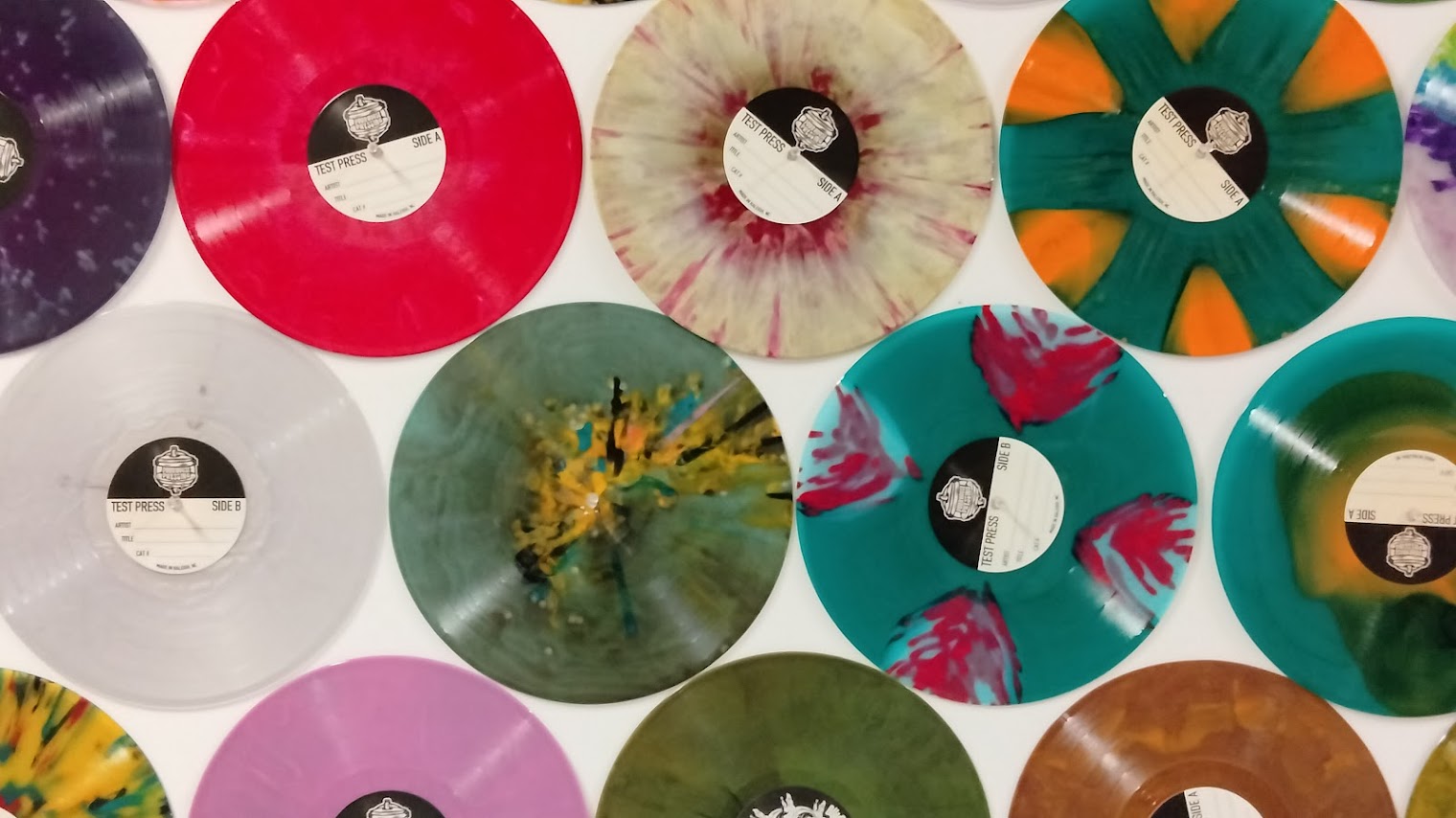
One of the cool things about the Pour House Pressing is their use of multi color vinyl to make each record an individual work of art. There was a wide array of colored PVC pellets in the containers to brighten up the music.
Bands really enjoy being able to make their records be more than black vinyl. “They come in and we brainstorm,” Lacie said. “We look at the wall.” The walls of the factory have numerous records on display with wild colors and patterns. A few bands enjoy mixing up the colors when they go back for additional pressings. She pointed out a record on the wall. “This is our third pressing for that band. They’ve come through and they’re like, ‘The next one, we want this.’ That happens often.”
The mixing of the PVC pellets to make a colorful record is an art form. “One of our press operators used to be a chef. When we hired him, we were looking for somebody that could take apart things and get creative,” she said. “How would you make this a meal? How would you make one of these and go crazy with it?”
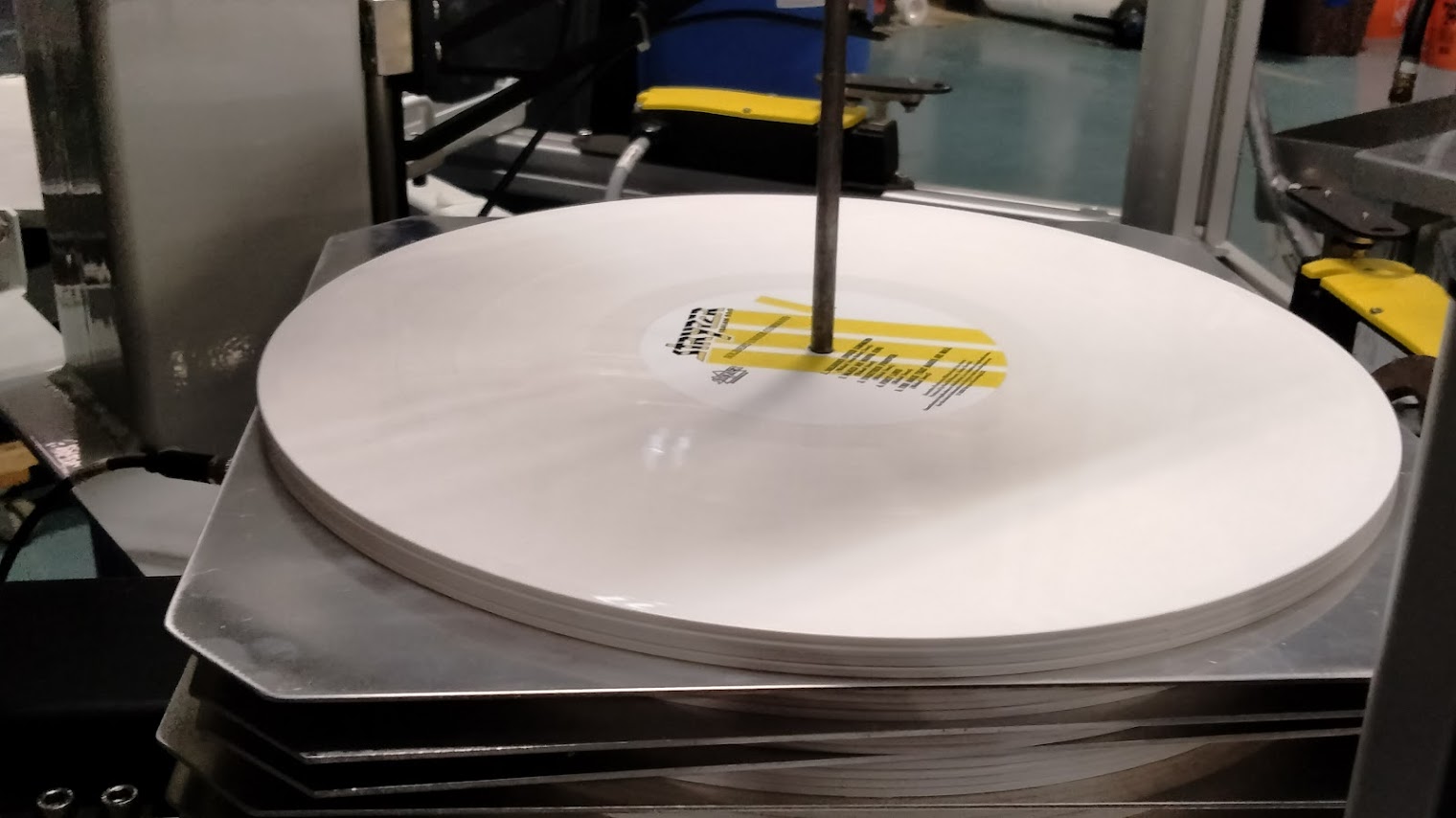
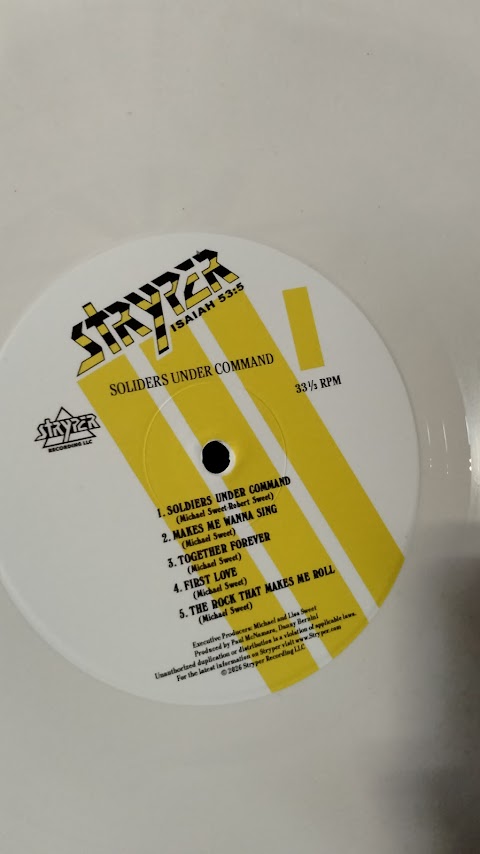
I didn’t get to see any wild color combinations being pressed. The album being manufactured during my visit was a special edition of Stryper’s Soldiers Under Command that naturally was made with pure white vinyl.
Lacie’s proud about the record series that combines all three of the Pour House businesses. “We do Live at the Pour House releases. We record the show at the venue and then press the limited edition record. Those are just really cool. We’ve done five. We sell those from our shop and then donate some to the band and they can sell them as merch.” Drop by the store at 224 S Blount St to experience the vinyl unification.
If your band is looking for a record pressing plant, you can reach Lacie at Pour House Pressing.
Joseph Corey III is the mastermind of the Casino Audiophiles whose Darmstadt ‘74 album is about his youth in West Germany in the early ’70s. He is wrapping up ’80s Teen Flick Festival Guidebook: Deep Cuts that’s evolved into an autobiography that seeps out of a fictional film festival. He is the primary home video reviewer at the InsidePulse website.