
On Peter Gabriel's "Melt" and Steve Biko
Published on Feb 21, 2026
Be Sure to Wear Flowers in Your Hair
Published on Jan 19, 2026
WALK OUT TO WINTER: falling in love with—and to—Aztec Camera's High Land, Hard Rain
Published on Dec 26, 2025
First Anniversary
Published on Dec 17, 2025
More Liner Notes…
Featured Essay: All the Lives I’ll Never Live: Wandering Through Time on Vinyl
by Jeffrey Davies
“I love this song.” I’m in the car with my mom, driving back home to the suburbs after a trip downtown during my spring break in eighth grade. Her Toyota RAV4 has a six-CD changer, and never has this particular car radio not had six CDs ready to go in it. We’re listening to a specific disc that has “Deb’s Mixed CD” written on it in Sharpie. My aunt, who works in radio, made it for her in what I can only presume now was the peak of the Napster era, when mixtapes quickly transitioned from cassette to disc.
I’m laughing because she loves every song on this CD; it was made for her by someone who knows her favorite songs. I tell her as much, but she doesn’t hear me. She’s too busy cranking the volume to almost as high as it can go and singing at the top of her lungs, an action I would come to appreciate more in a few years’ time when I got my own driver’s license. But in that moment, my mom had a look on her face that she only gets when listening to music she loves. It’s an obviously happy one, but also a face that always signified to me that these songs released before I was born are an inside joke between her and the rest of the world that I had yet to experience.
Nothing fascinated me more as a teenager than trying to deduce what made my parents like things—things from a past era, one where I didn’t yet exist—during a phase where I was struggling to find my own firm sense of identity for the first time. I found myself more naturally gravitating towards the musical interests of my mother, even though I remain forever grateful to my father for introducing me to Carole King’s Tapestry album around the same age.
My mom is the epitome of a sixties baby, born at the end of the Baby Boomers but before the true dawn of Gen X. She came of age in the height of the post-disco era and club culture of the eighties, which is to say she isn’t someone who can necessarily recall the correct name of a song or who sings it. But whenever a song she likes comes on, she will belt out every verse, whether she knows the lyrics or not.
That’s where I came in. I made it my mission to import every last burned CD that my aunt had made for my mom that she kept in the car. iTunes helped me out a bit when it came to titles and artists, but not always. In the years that followed, if any of those songs happened to start playing on shuffle mode on the iPod Classic I used for far too long—like “I’m In Love” by Evelyn “Champagne” King or Shannon’s “Give Me Tonight”—I regarded them with a nostalgic grin, a fun memory from a time that’s otherwise tainted by homophobic bullying or not having many friends. It was only when I started collecting vinyl that I realized the mark left by my mother and her music on both my taste and my sense of self.
Although I hate to admit it, because it’s just another sign that I came of age in the wrong era, my introduction to vinyl records was amidst the vinyl resurgence of the 2010s. A lifelong enthusiast of physical media, I easily gravitated towards music on vinyl, even when I had no way of listening to it. I grew tired of seeing freshly pressed albums on vinyl in trendy stores like Urban Outfitters or Indigo without a way to take up the hobby myself. I asked for and received my first record player for Christmas in 2017 and never looked back. As a university student commuting to and from the city each day, I soon discovered a world entirely new to me, that of the urban record store.
It was at shops like these where I learned the art of buying and collecting used vinyl. Even if a very low price likely indicates an LP in poor shape, sometimes the act of owning an album on vinyl that is very hard to locate in the format satisfies the audiophile within. As I started making special excursions downtown to these record stores, I realized that it’s often best to have an idea of what you might be looking for that day.
Unlike window-shopping for books, shopping for vinyl can be tedious when your fingers have to sift through aisles and aisles worth of albums, and you don’t even know what you’re looking for. So when I would walk into these often grungy, underground shops to browse for music on vinyl that has been in existence longer than I have, I would resort to the artists and titles of yesteryear that played a hand in raising me: those on my mom’s mixed CDs.
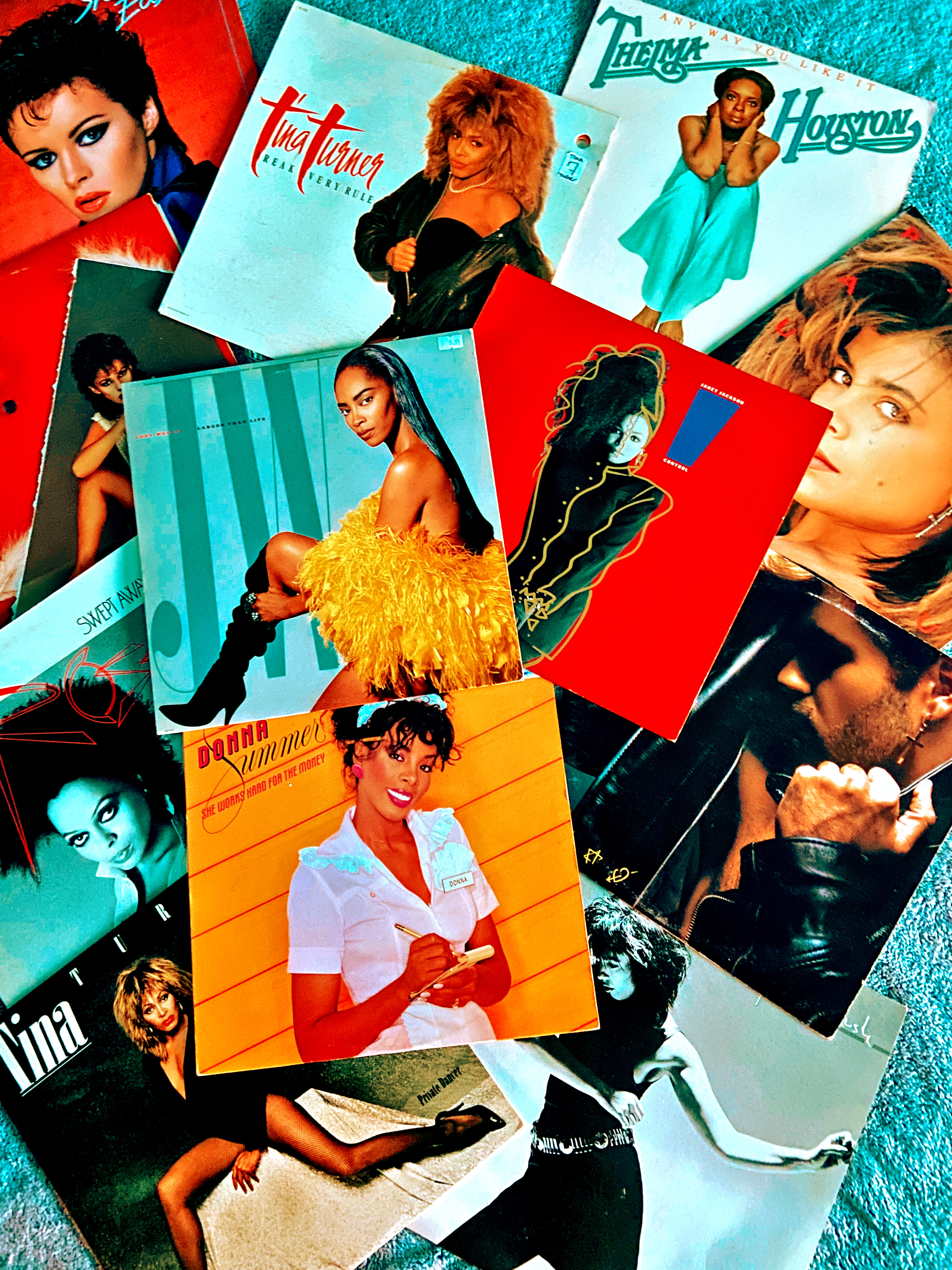
Finding my first Paula Abdul vinyl was a particularly good day early in my vinyl-collecting career. Donna Summer, Sheena Easton, and Belinda Carlisle proved quite easy to find, and still do. Harder were George Michael and Wham!, and harder still were Janet Jackson, Vicki Sue Robinson, Toni Braxton, and CeCe Peniston. The labels of many of these artists have since taken to repressing several of their albums on vinyl for the first time in decades to keep up with the demands made by fans and collectors old and new, but many are still lost to time—unless you’re determined to keep digging.
That’s how I at long last found Michael’s Faith on vinyl in average condition, and before that Jackson’s Control, then Thelma Houston’s Any Way You Like It. “Don’t Leave Me This Way” from the latter was a noteworthy favorite in my mom’s car, a song that I would later joke about on social media: “Every time you listen to ‘Don’t Leave Me This Way’ by Thelma Houston, a gay angel gets his wings.”
It wasn’t really a joke, though. In my mid-twenties, long since comfortable with my queerness, I began a playlist, mostly out of boredom, composed of songs to make the listener feel gayer. It was mostly music that I found motivating enough to keep me physically active during the pandemic years, comprised of many modern favorites by pop divas of the 2000s and 2010s. But before long, the playlist took on a distinctly retro vibe that was instantly reminiscent of those high school days in my mother’s car.
If a gay angel gets his wings during “Don’t Leave Me This Way,” he certainly starts to fly the first time he hears Madonna’s “Lucky Star” and finds his voice during “Tell It to My Heart” by Taylor Dayne. Although I didn’t know it at the time, my mom’s own taste in music was quite formative for my own. And while I had spent a fairly equal amount of time in my dad’s truck listening to the Beatles and Jimmy Buffett, my musical tastes have always been reflective of the diva that I like to believe lives in a little bit of all of us.
I didn’t realize until recently the size of the used vinyl collection I have amassed in under a decade. While my collection of new vinyl is equally as packed with new pressings of Madonna and Wham! albums, it’s the vinyl that I had to go digging for that means the most to me as a collector. Some of them are scratched beyond use or simply too old to function anymore, but I can’t bring myself to part with them. They remind me of the scared, anxious kid who didn’t know which type of music he was allowed to like anymore, the one who secretly delighted in repeated plays of “So Emotional” by Whitney Houston.
Like the parts of myself that I’ve kept hidden, a lot of the used vinyl I own are the LPs that have always existed just under the radar. Maybe Jody Watley’s Larger Than Life album hasn’t transcended time the same way as Cher’s Heart of Stone, but I get to give a home to a used vinyl copy. Sentimentality seems almost like a requirement in collecting vinyl, I find, because it involves the physical act of holding a full-sized version of an album that those of my generation might only have known to exist on a screen. Or for those who are merely devout fans of music, we know that nothing beats the crackle of the surface noise that accompanies listening to a vinyl record.
For me, getting to own some of the pop albums that defined portions of my mom’s life feels not only like preserving a part of her but also a part of a culture, a moment in time, that I would have never gotten the chance to experience otherwise. It turns out time machines do exist. All you have to do is drop the needle.
Jeffrey Davies (he/him) is a professional introvert and writer with imposter syndrome whose work spans the worlds of pop culture, books, music, feminism, and mental health. His work has appeared on HuffPost, CBC Arts, Book Riot, Collider, Slant Magazine, PopMatters, and other places. His book Self-Analysis Addict: Essays on the Pop Culture That Raised Me is available here.