
On Peter Gabriel's "Melt" and Steve Biko
Published on Feb 21, 2026
Be Sure to Wear Flowers in Your Hair
Published on Jan 19, 2026
WALK OUT TO WINTER: falling in love with—and to—Aztec Camera's High Land, Hard Rain
Published on Dec 26, 2025
First Anniversary
Published on Dec 17, 2025
More Liner Notes…
Featured Essay: Celebrating 30 Years of Propagandhi’s Less Talk, More Rock
by Greg Soden
Photograph: Petrina Piro
When Chris Hannah, Jord Samolesky, and John K. Samson of Propagandhi set out to record Less Talk, More Rock in 1995, they purposefully set out to create a record that would split their fanbase, challenge the culture of the music scene around them, and require two full recording sessions.
At the time, Fat Wreck Chords was in its boom years, expanding from an apartment to a downtown San Francisco headquarters, and surfing a wave of mid‑90s punk popularity. It seemed limitless. After 1993’s debut record “How to Clean Everything,” Propagandhi felt themselves adrift and at-odds from the scene’s growing commercial polish. They wanted their second album to reject the misogynistic frat‑friendly humor and homophobia embedded in parts of the skate‑punk world. They wanted a record that would challenge, not flatter, its listeners.
There was a huge problem, though. When they first drove 30 hours from Winnipeg, Manitoba to San Francisco, California to record the new album, the songs weren’t finished.
In their first attempt at Razor’s Edge Studio, they had only a handful of tracks, roughly ten minute’s worth, with completed lyrics. Chris Hannah believed he could finish the rest by staying up at night alone in the studio. Instead, he experienced what felt like a night of genuine haunting complete with paralysis, strange noises, the sense of a figure sitting on his chest. When he reported this the next morning, engineer Ryan Greene suggested the studio monitors once flew off his desk by themselves. Assistant engineer Tim Daly added that a snuff film was rumored to have been shot in the lounge.
The band realized their failure and bailed. Weeks wasted. They drove home. In the first session, some songs were completed, including early versions of “…And We Thought That Nation-States Were a Bad Idea,” “Resisting Tyrannical Government, “ and “Refusing to be a Man,” and a partially finished song that came to be known as “Contest Song.” All of these early versions appeared years later on the 1998 G7 Welcoming Committee Records release “Where Quantity is Job #1.” Another partially finished song appeared decades later, completed as “Pyroclastic Flow” on Chris Hannah’s Patreon account.
Months later, they returned to Razor’s Edge in January 1996, fully prepared to record. The second attempt went smoothly. They completed the album, mastered it, then realized the song order was wrong and paid for an expensive second mastering session. For a young band, it was a painful expense borne of inexperience.
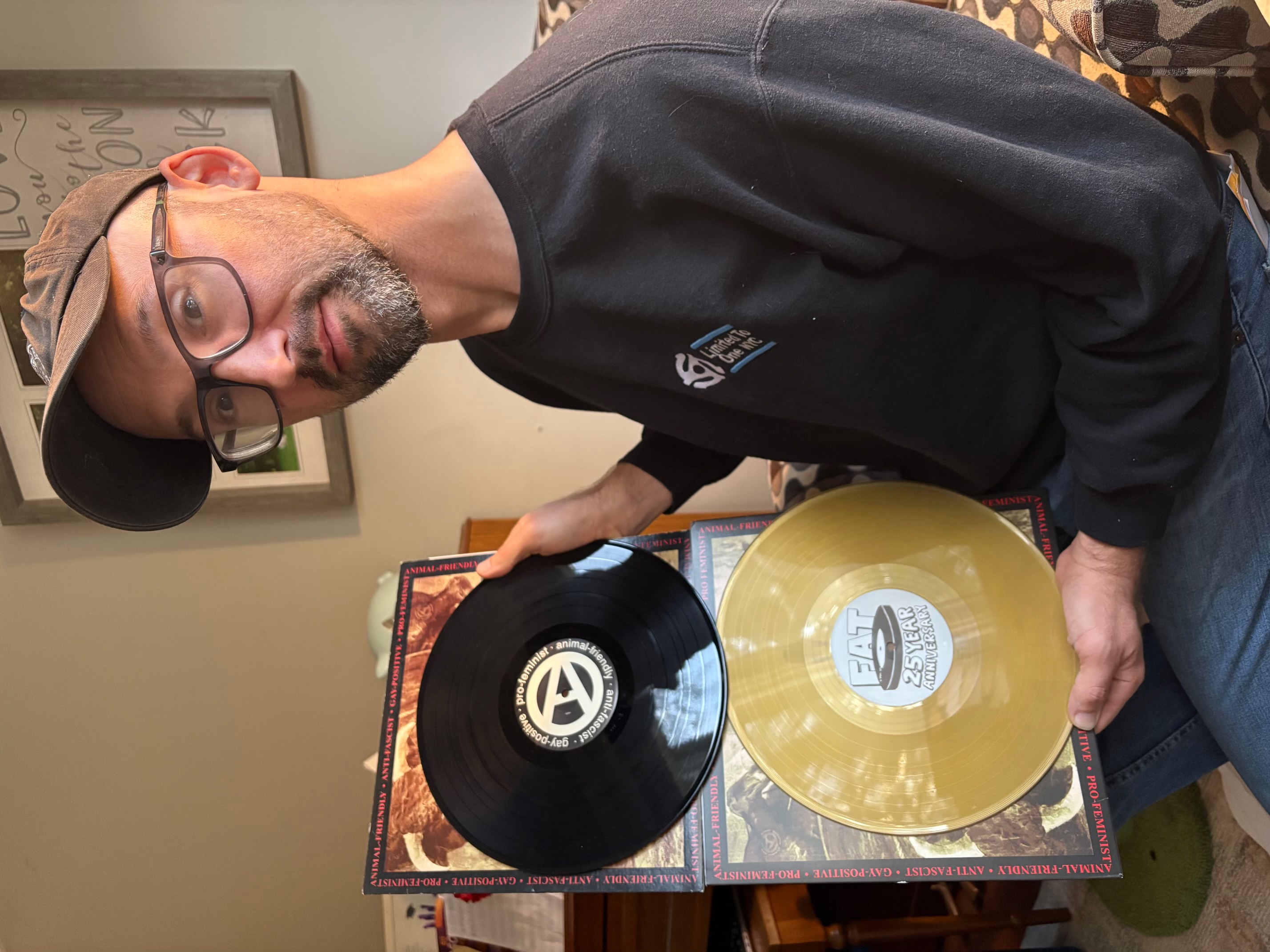
Politically, the band refused to soft‑pedal or be vague. The cover proudly declared: “GAY‑POSITIVE- PRO‑FEMINIST-ANIMAL-FRIENDLY-ANTI-FASCIST” on the perimeter of the front cover, signaling a break with some of the overlooked or lazily misunderstood messages of their debut. The vinyl LP’s back cover included the fully printed lyrics. They wrote songs that, among many other things, confronted patriarchy (Refusing to Be a Man, named after the John Stoltenberg book of the same name, suggested to Chris Hannah by bassist John K. Samson), the animal-industrial complex (Apparently I’m a P.C. Fascist/Nailing Descartes to the Wall), American neo-colonialism (A Public Disservice Announcement/…And We Thought That Nation States Were a Bad Idea), corrupted election politics (The State Lottery), and homophobic bro culture (Less Talk, More Rock). These were subjects Chris Hannah was wrestling with intensely after his first encounters with growing up on a military base.
The musical dynamic in the band was also shifting. Bassist and co‑vocalist John K. Samson brought a melodic, literary style that sometimes blended beautifully with Chris and Jord’s metallic instincts and sometimes clashed. One moment cemented the divergence: when Chris tried to teach John a Venom riff for a cover song of “Stand Up and Be Counted” from the “At War With Satan” LP, John, a very capable bassist who rarely struggled with the band’s songs, didn’t find his rhythm. Both Chris and John quietly realized they didn’t share the same musical DNA or goals. Samson would soon depart Propagandhi, briefly play bass in a Winnipeg band called Dud (with Bonaduces guitarist Mike Koop and I-Spy drummer James Ash) and then went on to form The Weakerthans. The Weakerthans later reimagined previously the released Propagandhi songs Letter of Resignation and Anchorless in their 1997 G-7 Welcoming Committee debut LP, “Fallow.”.
But the last record the band completed together with the John K. Samson lineup was so special. When Less Talk, More Rock came out, many fans of the debut recoiled. The humor was stripped back. The politics and mission of the band were front and center. The music was heavier and less goofy. Gone were the days of songs like “This Might be Satire” or “Ska Sucks” or Cheap Trick covers. But for the listeners who needed it, such as the folks who didn’t fit into the macho punk scene, the album became, and remains, a beacon.
Less Talk, More Rock wasn’t the biggest Propagandhi record. On it, they became themselves: uncompromising, evolving, and utterly unwilling to cater to the lowest common denominator. It is not this author’s favorite Propagandhi record, but in my view it is not only the most important Propagandhi record, but one of the most important rock records ever recorded.
About the Author Greg Soden is the host of Unscripted Moments: A Podcast About Propagandhi. As well as being a lifelong Propagandhi fan, Greg is a father, partner, teacher, and cyclist. He is originally from Missouri, USA but has travelled and lived all over, including the UK, Mexico and Canada. He now resides in Buffalo, New York, where he roots for the Buffalo Bills.