
On Peter Gabriel's "Melt" and Steve Biko
Published on Feb 21, 2026
Be Sure to Wear Flowers in Your Hair
Published on Jan 19, 2026
WALK OUT TO WINTER: falling in love with—and to—Aztec Camera's High Land, Hard Rain
Published on Dec 26, 2025
First Anniversary
Published on Dec 17, 2025
More Liner Notes…
Featured Essay: Come Out of the Corner: The Ultimate Robyn Deep Cuts
by Bradley Spinelli
Intro:
I can’t remember where I was when I first saw the video for “Konichiwa Bitches.” I think it was Guatemala City? For a while, I was convinced it was Malta, but that trip was before Robyn, her 2005 self-titled album, came out. As she puts it, “Can’t take all these memories / Don’t know how to use them.” What I know for sure is that I was staying in a hotel I could not afford, paid for by an airline due to a canceled flight, with a television with a music channel.
Robyn, on a jumbo prop telephone, tells her sock monkey drummer, “Give me something illicit, like it’ll get you in trouble or somethin’,” before snapping, “And you know, pick it up!” The video is bonkers, a PeeWee’s Playhouse dreamscape. The lyrics upend rap tropes with middle-school disses—“Count you out, like a mathematician”—and defiant lowkey swagger: “You know I fill my cups no need to supersize ‘em.”
I was like, What is this? And, I love it.
When my friend Hols, who used to jump around the Blue Room with my then-girlfriend during the most nascent years of Toozday Night Dance Party, turned me on to “Call Your Girlfriend,” I was all in.
By the time Body Talk broke big, every rag was calling her “the Queen of Sad Bangers.” I find it reductive. You don’t have to read a psychotherapy paper to know that sadness is a common human emotion, or look at a Billboard chart to know that a lot of popular music is about sadness. In this country, we have at least three major musical genres explicitly built on another that’s literally called “the blues.” Joy may be where humans thrive, but sadness is where we live.
The “Sad” moniker misses the rest of Robyn, a joyful weirdo with eclectic tastes that side-step rules of mainstream “branding.” If you only know that one song, or one album, or only the releases under her own name, you really don’t know Robyn. She may never be as big as Billie or Ariana or (cough) Taylor, but her effortless metamorphoses make comparisons to Madonna, or Bjork, or Prince far from hyperbolic.
Over the next decade, Robyn became my favorite, in a kind of self-identifying way, like how friends know that you like to wear a certain color. Robyn became the centerpiece of my DJ sets—no dance party would be complete without a well-timed Robyn drop, often a rare remix passing as an innocuous house beat before the singular voice and recognizable melody started to soar.
She’s not my favorite because I necessarily think her music is the best in the world, or because I play her music more than any other artist (that might be Lowly, who tend to come out every Sunday). She’s my Number 1 because I love her music as a fan, as a DJ, and as a record collector. The three overlap but are distinct domains.
(Skip to Part 3 to “get me right where the hurt is” if you’re not a head or a nerd, but you’ll miss all the deep cuts recs.)
1. DJ
As a self-taught DJ, I started with hiphop in the early aughts, which is as much a skill/equipment aesthetic as a music choice. Not to lose non-heads in jargon, but I never learned how to use CD turntables, Serato, or any kind of “controller” with a laptop. I only spin vinyl records—those big discs from the ‘70s that are heavy as hell to lug around. What I can play is limited to what has been released on vinyl, and if I can find it. Just because it’s on Spotify doesn’t mean I can put my hands on it—and I have stuff that Spotify doesn’t.
I was the wrong demographic to know Robyn’s ’95 debut, or the two albums that followed. I was interested in her independent era, and finding Robyn on wax raised immediate difficulties. The EP Body Talk Pt. 1 was available, but the full vinyl version of Body Talk was going for over $100. Back then, I didn’t want to spend $100 on a record (how cheap things were in 2009; within a year it was going for $300). Her 2005 eponymous indy barely existed at all—a limited German pressing is, as of today, only owned by 119 listeners on Discogs.
I started poking around for 12-inches—single remix records that may have only one track on each side, are usually 45 RPM, and can stretch a three-minute album track into seven minutes. When you’re blending two tracks, a longer remix opens up the possibilities. You want to get people moving, sure, but as a sheer exercise of joy, you want to find those moments where two different records appear to talk to each other, creating a previously-unheard third sound.
Robyn has put out quite a few 12-inches. The hit “With Every Heartbeat” has been released, by my count, on seven different non-album vinyl records, with eight different remixes. By the time Robyn dropped Honey, her dedication to the dance floor was demonstrated to be peerless. She preceded it with the RMXRBN series, five records of remixes from Robyn and Body Talk*, and followed it with a limited series (500 copies each!) of remixes from Honey. Any DJ worth their salt could keep you on your feet for an hour with just these nine records.
In COVID lockdown, our answer to sadness and isolation was to host Toozday Night Dance parties with our friends via Zoom and MixCloud, and I trotted out my Robyn rarities. By the tail end of 2020, I was fully obsessed with creating a full-album remix of Honey.
(The full hour may only be for the most vicious Stans, who would probably be offended—but I stand by the mashup of “Human Being” vs Soulwax’s “KracK.”)
*Nerds: the series also includes two tracks from My Truth, and the Robyn & Kindness “Who Do You Love.”
EIGHT ROBYN DEEP CUTS
“Do You Know (What It Takes) (E-Smoove Bounce Mix),” 1996
It’s easy to forget what era Robyn broke out of, and her wonderfully dated R&B is a timewarp. Her voice is perfectly malleable for the form, radio ready. This track is built on a Hall & Oates sample (“I Can’t Go For That”), twenty years before The xx blew everyone’s minds for doing the same.
“SayIt”—Röyksopp & Robyn—Do It Again, 2014
This EP is legendary, from the hooky title track to the long version of “Monument” (a shorter version appears on Röyksopp’s The Inevitable End). At almost seven minutes, “Monument” is “The Low Spark of High Heeled Boys” of electronica, complete with saxophone solo. But the throbbing synth of“SayIt” is combustible. Played alone, it’s incendiary, and dropped on top of another beat, it’s pure fire. It peaks with a demented end: Robyn trading “I want you”s with a robot, who declares himself a “pleasure machine; fuck mechanic.” If this is a sequel to Röyksopp & Robyn’s “The Girl and the Robot,” I’m holding out for Part III.
“Handle Me (Chopstick & Johnjon Remix),” 2008
“Handle Me” is another track with multiple remixes—ten by my count on wax. This one is my favorite for heavy sets. The chopped and screwed lyric at the top, the loping synth rhythm that doesn’t show up for two minutes and doesn’t truly settle until around 4:35, dropping at 5:30 and taking over the room. How fun this is to mix into, and you’ve still got two minutes to do something crazy before you have to get out.
“Got to Work It Out”—La Bagatelle Magique—Love Is Free, 2015
Christian Falk’s death famously influenced Robyn’s Honey, but also led her to cancel the last scheduled shows with their group La Bagatelle Magique. The album doesn’t get the attention of her other releases, but is wonderfully danceable house music, every cut a DJ-friendly length. This track has a ruthlessly ‘80s backbone, from the wet snare to the robot-speak, before Robyn strides in, surrounded by smoke machines, and tells us, “make a fist and pump it like this.”
“Indestructible (Laserkraft 3D remix),” 2011
The German-only vinyl release, with an utterly cute Polaroid shot of Robyn, is totally rare, with only 63 owners on Discogs. One of her strongest songs—“I’m gonna love you like I’ve never been hurt before”—this version does exactly what a great remix should: it holds its cards. Her vocal sneaks in a minute in, but only to disclose the track name and more fully obscure anything recognizable from the album version. We’re a pulsating, sweat-dripping three minutes in before the chorus starts, hitting like a brick wall.
[Image: Indestructible polaroid.jpg (or linked above)]
“Ever Again (Soulwax Remix),” 2020
Soulwax are brilliant, full stop. But apart from their own releases, they’ve made a cottage industry out of remixing other artists. Their experience as mashup artists has made them uniquely skilled at finding a hidden germ and blowing it out into something unrecognizable. (One bananas example: “Daft Punk Is Playing At My House [Soulwax Shibuya Mix].”) The last track off of Honey, this song has a wonderful lightness, giving a sad record an uplifting ending. “Go ahead and try a little crazy on me” is optimistic without being naive about the realities of human engagement. Soulwax’s funky remix slows it down just a hair, letting the snare settle and opening up space for Robyn to chat it out. The winner of the Honey remixes, despite solid competition.
“When Doves Cry” (Prince), On Track with SEAT, 2011 (at 6:00 at link)
Purists will ask, should Robyn be covering Prince? But she’s European, and isn’t as hung up as we are—this is the same woman who covered “Cobrastyle” and owned it. I don’t mix this as a DJ, but will throw it on as a curiosity. It’s not that it’s so good, but it’s interesting to see someone pay homage so honestly. (Recorded for the Channel 4 series, this is another vinyl rarity, only 32 owners on Discogs.)
“Dancing On My Own (Fred Falke Remix),” About:Berlin Vol:6, 2014
Among the various terrible remixes of Robyn’s signature anthem, this one is fantastic. Vinyl DJs will be unhappy to learn that it’s embedded in a four-disc album that’ll run you a hundred Euro and up, plus shipping. (Supposedly it was on the CD single promo, which two people on Discogs claim to own.) But it does its job, reimagining the orchestration, finding new grooves, and stretching it out. The prominent bass line gives it more of a rock thump, while keeping to the well-worn verse/chorus structure. At around 4:30, the familiar arpeggio sneaks in under stacked vocals, setting up the last chorus and leaving plenty of time to mix out. With a slightly higher tempo, it’s tricky to drop from the remix back into the original, but you probably won’t have to.
2. Wax
Everyone went a little cuckoo during COVID, and many found unique ways out of it. By late 2021, I was asking what seemed to be a forgotten question: Where is the new Robyn album? There had been rumors, but nothing substantial, and we were still two years away from finding out about her motherhood journey. I had most of her songs on vinyl already… but what about her appearances?
This is the part of the movie where the middle-aged white guy goes crazy with red string on a corkboard. In my case, I scoured Discogs, the Wikipedia of music releases and the global trading post for physical media. I created a dizzying Excel spreadsheet of encyclopedic results, an infinite work in progress (and truly for Stans only). I went shopping, paying an embarrassing amount in UK and EU shipping costs, trying to cop every vinyl appearance in Robyn’s indy era.
The sheer breadth and variety of Robyn’s guest appearances draws an almost ridiculous constellation. This is an artist who hasn’t taken much time off. There are hooks: a loping, tempo-shifting song from Metronomy; “Never Will Be Mine (R3hab Remix)” by Rye Rye adds a fast rap over heavy synths, using Robyn’s chorus as a trance break; the Lonely Island tapped her for a SNL sketch. She features on a Jónsi record, on the pop/punk of I Blame Coco—if you didn’t know Sting has a kid who also makes music—and on a Lorde song, doing spoken word. There are oddities, like the late night, barely-vocalized turn as “M.C. Robyn” on Mr. Tophat’s 11-minute flute-heavy “Hedonism.” Todd Rundgren’s album White Night is great trivia if you didn’t know that Robyn, Joe Walsh, and Trent Reznor all appeared on a single record. She had a disappointingly short walk-on to Brat Summer, but penned the line, “I started so young, I didn’t even have email; Now my lyrics on your booby.”
The search is itself an adventure. I ordered Kleerup’s 7-inch “With Every Heartbeat (Meatboys Remix)” from Japan, and received a totally different record. The seller left it up to me to figure out that my record went to a lawyer in the Pacific Northwest, who apologized for taking so long to respond because he was in the middle of a murder trial. We didn’t become best friends, but we both got our records eventually. I can’t even link you to the track, because a full version doesn’t appear to exist digitally. It’s almost refreshing.
One can find truly wonderful ephemera by digging. The limited edition (300 copies) 7-inch of “Bum Like You” by now-defunct Dolores Recordings has ridiculously cute drawings.
[Image: Delores bum like you.jpg (or linked above)]
In London in 2024, I asked every shop I visited for the last White Whale on my list, the UK-only Mad Decent Vol. 1, which contains Savage Skulls & Douste’s “Bad Gal (Mikix The Cat Remix),” the only vinyl version of an obscure Body Talk Part 2 track. The record popped up a few weeks later in Philadelphia. Why do you care? You don’t. Buying records is its own disease, and it has almost nothing to do with listening to music.
Some clues are more telling than others. The 2021 rerelease of Beverly Glenn-Copeland’s Keyboard Fantasies came with liner notes written by Robyn. She opens with, “Not all, but the best artists are like tourist guides waiting at the brink of an emotional landscape, waving their flag, greeting the arriving visitors to their new destination. ‘Welcome to Sadness, let me show you around!’”
EIGHT ROBYN APPEARANCE DEEP CUTS
“Life”—Jamie XX—In Waves, 2024
I’ve told everyone who would listen that this album was the most important dance release of 2024 (and it held that spot until the vinyl version of Tove Lo and S.G. Lewis’s Heat finally dropped in September, 2025). This record is a front-to-back banger, with built-in dance breaks. Robyn appears on a track built around a delirious horn section sample from 1977’s “The House Of The Rising Sun + Revelacion Suite.” What’s so knock-down drag-out about it is it’s just so Jamie and yet also just so Robyn. Uplifting, celebratory, and utterly bizarre: what’s giving her life also gave us “strong torso.” I’m not sure what she means, but I can’t stop repeating it.
“Piece of Me”—Britney Spears—Blackout, 2007
Britney’s voice has so many effects on it, making her sound so robotic, one wonders if they were trying to make her sound like Robyn. But when Robyn, on backup vocals, echoes the title, it’s in a clean, unfiltered voice, instantly recognizable. A zillion pundits have said the two names in one sentence, since Britney became the tabloid Lolita that Robyn didn’t. But it hits a bit harder now, as Britney sings about how she’s been in magazines since she was 17, and also about “bein’ a mama / And with a kid on my arm,” beating Robyn to the mom punch by almost twenty years. It’s a shame this song never truly takes off—a remix with a decent breakdown and a more ecstatic climax could be a jam.
“Call My Name”—Smile —Phantom Island, 2022
Such a classic, honest Robyn offering, it could have appeared on any of her albums. Not to be confused with The Smile, Smile is a Swedish export by Björn Yttling (Peter Bjorn and John) and Joakim Åhlund (Teddybears), so it’s a no-brainer that they asked her to sit in. I’m glad they did, because it’s a great album I would have otherwise missed.
“Sensual Seduction (Fyre Department Remix)”—Snoop Dogg, 2007
I won’t waste column inches griping about Snoop’s various betrayals felt by everyone who bought his debut in 1993, but it’s fair to say Robyn would have heard that album then, and would have said “yes” the second Snoop called. This version is pretty good, with climbing arpeggiated synths and Robyn on the hook and with a few guest bars. And it beats “U Should Know Better feat. Snoop Dogg”—people forget that Body Talk had some misses.
“Out of the Black”— Neneh Cherry—Blank Project, 2014
Did you know Neneh Cherry is Swedish? Her birth name was Karlsson, before her mom married Don Cherry. A straight four-four strut with a fat fuzz bass, you’d like to hear these women croon this one in a smoke-filled club—capped by a frenetic solo, on what I suspect is an organ manned by Paul Simm. A must.
“Hey U”—Basement Jaxx—Crazy Itch Radio, 2006
I don’t know what this is. It opens with what one might hear walking down the street in Puerto Rico, but the more it comes unraveled, the more convincing it passes as klezmer. Robyn is as comfortable as ever singing over it, getting out of the way as the chorus goes full Fiddler on the Roof. The end breakdown truly leaves you wondering where you are, and how you got there. Whatever this is, it’s singular and amazing.
“All My Love”—Louie Vega—Expansions in the NYC, 2022
This entire album is such old-school house that it’s pure joy. Robyn represents, on a track that would be unassuming were it released thirty years ago. Heads and DJs should check out the remix 12-inch, with multiple options by Honey Dijon and others. Remember, “Little Louie” Vega produced “Good Thang” back in 1999.
“Hang with Me”—Liberty and Justice—Pressure, 2022 (cover)
It may be a cheat to mention a cover, but when it’s so transformative, a cover is a blessing. This is just heavy.
3. Fan
I wasn’t cool enough to see Robyn at any small venues during the Body Talk Tour. When I started covering bands for New York magazine’s Bedford+Bowery, I went to live shows heavily, but most of my beat was Pixies-descended indy rock. I became a bit Jekyll and Hyde—rock music in the clubs, dance music at home on the decks.
We saw an early stop on the Honey Tour at Madison Square Garden in 2019. Afterwards, as the crowd wound its way down the endless stairs, people started singing “Dancing On My Own,” a virulent refrain that carried right into the subway. We stood on the tracks with every other misfit shouting, “I’m in the corner!” a scene that went viral.
The better story was seeing her again at the end of the tour at Barclays. The crowd felt warmer, maybe a little less bridge and tunnel, if I’m being bitchy. But it was the music. The band had been on the road, and was, unquestionably, a band. Songs I knew inside and out were remixed—inside and out—live, passed around like a jazz combo. We could feel the electricity coming off the stage. Robyn was loose, in her element, generous and open. It was a fantastic show.
In mid-2026, I started pitching a story about Robyn’s rarities. I haven’t published any music coverage since Bed+Bow shuttered during the pandemic, and it may not help my chances that half my stories evaporated when NYU migrated its servers (I feel for the student journalists who paid tuition fees to work there and may have lost even more). I was just another white guy behind a keyboard, fighting for a spot between legacy journalists with a deathgrip on the last gigs of their careers and the AI clankers cranking out the short form most people read.
Whatever, I’m a fan. When Robyn announced her Brooklyn New Year’s Eve show, I cleared the ticket release time on my calendar and was online like a sneaker drop. And I didn’t get tickets. Neither did anybody else.
The rollout was a disaster, endlessly trolled on Reddit. With a 2000-capacity room, we knew it would be tough, but fans were shocked that they never got into a virtual “line” nor found a field to enter their all-important “code.” Tickets were apparently sold out in seconds, but it took hours to get “sold out” notifications. Laylo and Ticketmaster both looked like scammers. Promoted as an “artist pre-sale,” it wasn’t followed by an actual “sale.” Were the conspiracy theories true?—“most tickets went to influencers or artist/label guests.” I didn’t buy the “bot” or “flipper” theories, because very few tickets were showing up on the secondary market. Once again, you lose.
Before the end of the day, I paid more money than I’ve ever paid for concert tickets to get a pair. No, I’m not telling, and people have asked. I will say that prices came down, and if I were a different kind of person, maybe I could have dealt with the anxiety of waiting it out.
I tried to get a comment on the ticket fiasco from Robyn’s management, but Young (Robyn’s management group) doesn’t have public-facing contact information. Sure, I still get a lot of press releases, and can probably get a freebie to a rock show in Bushwick, but “access” in this case wasn’t coming my way, another lesson in humility.
***
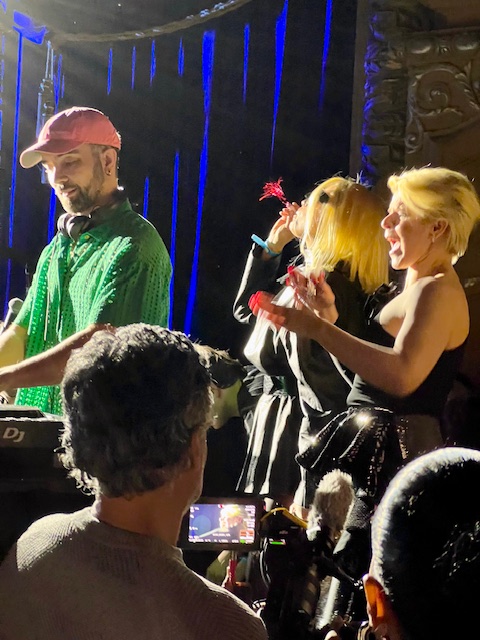
On New Year’s Eve, we showed up early and caught part of JADALAREIGN’s wicked set in the basement, which was the better space for pre-partying, with all the boys decked out like it was the Halloween Party at the Pines. We popped upstairs to the big room to see Danny Krivit—dude is pushing 70 and still cutting it up—then back down for Dee Diggs and my horrifying gender revenge of a bathroom line. The women’s was in/out, the men’s was worse than all the Halloween Parties I’ve been to at the Pines—a slow-motion mosh pit poured into a tight funnel, with the architecture conspiring to make it even harder to get out. Truly I say unto you, this crowd was all boys.
Downstairs was jumping, but we ran upstairs to catch the end of Olof Driejer’s set.
Those steeped in Swedish electronic music don’t need to be reminded that he was one-half of The Knife, possibly the best example of the subconscious dark undercurrent that powers all synth-based pop on the market. I had been electrified by Brujas, an EP I picked up in London, Olof’s production with Diva Cruz that is equal parts bumpin’ and bonkers. It is emphatically aggressive. You could only spin this after the entire dark basement dance mob had ingested a sufficient number of vodka/Red Bulls.
The set was going off. The crowd—hyped on NYE energy but holding it back for Robyn—wasn’t really dancing. I didn’t see any Red Bulls. We slipped around to house right and got about ten feet from the booth to watch Olof work.
Then, Robyn was there. I said something pithy, like, “Oh my god! It’s Robyn!” in a not-embarrassing high register. That was it. We were as close to brilliance as an un-credentialed journalist was going to get, but close enough to make other fans jelly. She and Olof briefly chatted quietly about the weather in Sweden, I imagine. Maluca was vogueing behind them. Robyn did the countdown, everyone cheered and kissed. For a hot second, we were at a small local show in Sweden, where everyone knows each other.
When Robyn took the stage—well, you’ve already read about the power cutting out. That didn’t phase me. But three songs in, rolling back through her albums in reverse order from Honey’s “Missing U” to Body Talk’s “Call Your Girlfriend,” she launched into Robyn’s “Cobrastyle,” and I lost my shit. That was the track I didn’t think I’d ever hear live, and I failed to keep my cool about it.
On “Ever Again,” it was clear that Robyn agrees about the Soulwax remix, because that’s what the band was playing, 100%. Slightly slower, with more of a swing, driven by bass and popping snare. Maybe her best song. “So many things we haven’t tried / We’re just getting started.”
“Dopamine” was the bop everyone expected, the first track we had all heard from the new wax. “Never Will Be Mine” was presented barebones, stripped down to nothing but her voice and a quiet piano. She cleverly linked this earlier track to Honey by quietly whispering, “I just miss U.” And then we were back up and dancing to “In Between the Lines,” and Maluca took the stage for La Bagatelle’s “Love is Free.”
Her take on “Don’t Fucking Tell Me What To Do” was to leave it off, just listing the things and not saying the “killing me” part, a genius level of crowd teasing.
After hearing new tracks “Sexistential” and “Talk to Me,” I had a miscount, not realizing that “Blow My Mind” was new, sort of, but a redux of a song before my time. “Monument” was a surprising crowd-pleaser, despite never appearing on a Robyn-only album. After the sing-along of “Indestructible,” she broke it down again for a sitting-on-a-stool, stripped-down rendition of “Show Me Love.”
Suddenly, the bathroom line clicked into place. I always assumed Robyn’s ’90s era belonged to elder Millennial girls, because of my friend who brought Robyn back to my attention. But I had it wrong: ’90s Robyn belongs to elder Millennial boys. This was an epic, groundbreaking appearance, a song she hadn’t played live in… who knows. I may not be a big fan of the song, but it’s moving to watch two thousand gay men sing a fucking anthem.
Robyn did an interview in 2010: “I think I’m making music for grown-ups who remember what it’s like to be a teenager.” She talked about “that feeling of not fitting in. The feeling of wanting to be understood and wanting to find a connection with other people,” adding, “I think all people feel like that when they’re young. They feel like they’re not understood.”
Who understands this more than gay teens in America? Are we still talking about sadness, or are we talking about coping with sadness? All of us, in a room, belting out a song together.
The encore choice should surprise no one. “Dancing On My Own” will forever be her “Seven Nation Army.” She just let the mic fall and gave us the first chorus. She let it hang in the air, a long pause, soaking it in, before launching into the second verse. In under an hour, she’d taken us all the way through her discography, dragging us into 2026.
Trudging out into the cold, I thought about the dialectic of the “Sad Banger,” and remembered Amanda Petrusich’s bone-cutting prose poem, appearing (believe it or not) in a profile on Beck: “The world is grim and hilarious; the future is bright and unthinkable; you are sad, but you are dancing; you are home, but it is not the same.”
Outtro:
In the following days, I watched stories multiply on the internet, each sounding like an AI rehash of the Brooklyn Vegan antecedent, apparently the only journalist at the show—besides Jia Tolentino, who was backstage. You could wait three months for her all-access coverage, if you have a New Yorker subscription. All the big outlets held their cards for features, interviews, and photo shoots tied-in with the album drop, which would come like a tsunami—as if nothing had changed in Big Media, and it could still command the sale of more units than Taylor, Wicked, and KPop Demon Hunters would move on Record Store Day. Meanwhile, fans grabbed for snacks on Reddit, where the real reporting was happening. It’s not news that technology has made communication worse, and turned storytellers into volunteers.
I kept thinking about what “Ever Again” was to me and what “Show Me Love” was to everyone else. I can appreciate the idea that no one understood me in high school—or college, or the years after. It wasn’t until my thirties that I began to understand myself, and my forties when I first had the inkling that I don’t need to care if anyone else understands me. “Don’t fucking tell me what to do” becomes less of a teen rebellion reflex and more of an unspoken “Whatever, nevermind.”
Everyone loves an underdog. One of the strongest pulls of Robyn’s music and her personality is the legend of someone who walked away from the mainstream, got herself together, and did it on her own. To launch a record label and self-release a self-titled album is so unbelievably punk, it speaks to freaks and losers and dweebs. Anyone who’s ever put a track on Soundcloud, started a blog, self-published a book—or even thought about it—can relate.
But the appeal isn’t limited to the creative class. If you’ve been passed over for a promotion, you’re in the corner. If you’ve been stood up or ghosted by a crush, you’re in the corner. If you missed a bus, got bumped from a flight, had your credit card scammed, got yelled at by a crazy on the subway, or missed out on a concert ticket for your favorite artist, you’re in the fucking corner. The corner is where we live, more often than we like to admit.
Like most humans, I stayed indoors on New Year’s Day. When the text came that Robyn was adding a show on January second, I let it go. Not trying again with that nonsense. But by late-afternoon on the second, people were dumping tickets, and I couldn’t pass up a chance to see her again for face value.
The set list was the same—this is a band practicing for a tour—but the crowd was looser, more relaxed and less hyped. There were way more women in the audience, and more dancing. And I was looser, able to pay attention and think more like a journalist and less like a Pavlov dog.
The biggest hit, the most savage crowd reaction—apart from the encore—was Jamie XX’s “Life.” Everyone knew it, everyone knew the words, even “strong torso.” It was joyful and exuberant, and reminded me how much I preferred Jamie’s “Dopamine” remix to the single version, an opinion that might seem blasphemous to any other artist. But Robyn has been working with the same people for decades, letting her joy and sadness infect others, taking their input and letting her ideas multiply.
I thought, You’re giving me the antidote. You’re extending your hand, saying, “Come out of the corner.”
“Welcome to Sadness, let me show you around!”
Bradley Spinelli is the author of the novels The Painted Gun and Killing Williamsburg—launched with Questlove DJing a “suicide set.” He was a regular contributor to New York magazine’s Bedford+Bowery (2014-2020), covering NYC bands and SXSW extensively, including then-unknowns like Slothrust, Sofi Tukker, and Halsey.