On Peter Gabriel's "Melt" and Steve Biko
Published on Feb 21, 2026
Be Sure to Wear Flowers in Your Hair
Published on Jan 19, 2026
WALK OUT TO WINTER: falling in love with—and to—Aztec Camera's High Land, Hard Rain
Published on Dec 26, 2025
First Anniversary
Published on Dec 17, 2025
More Liner Notes…
Featured Essay: Double Nickels on the Dime
by Russ Chibe
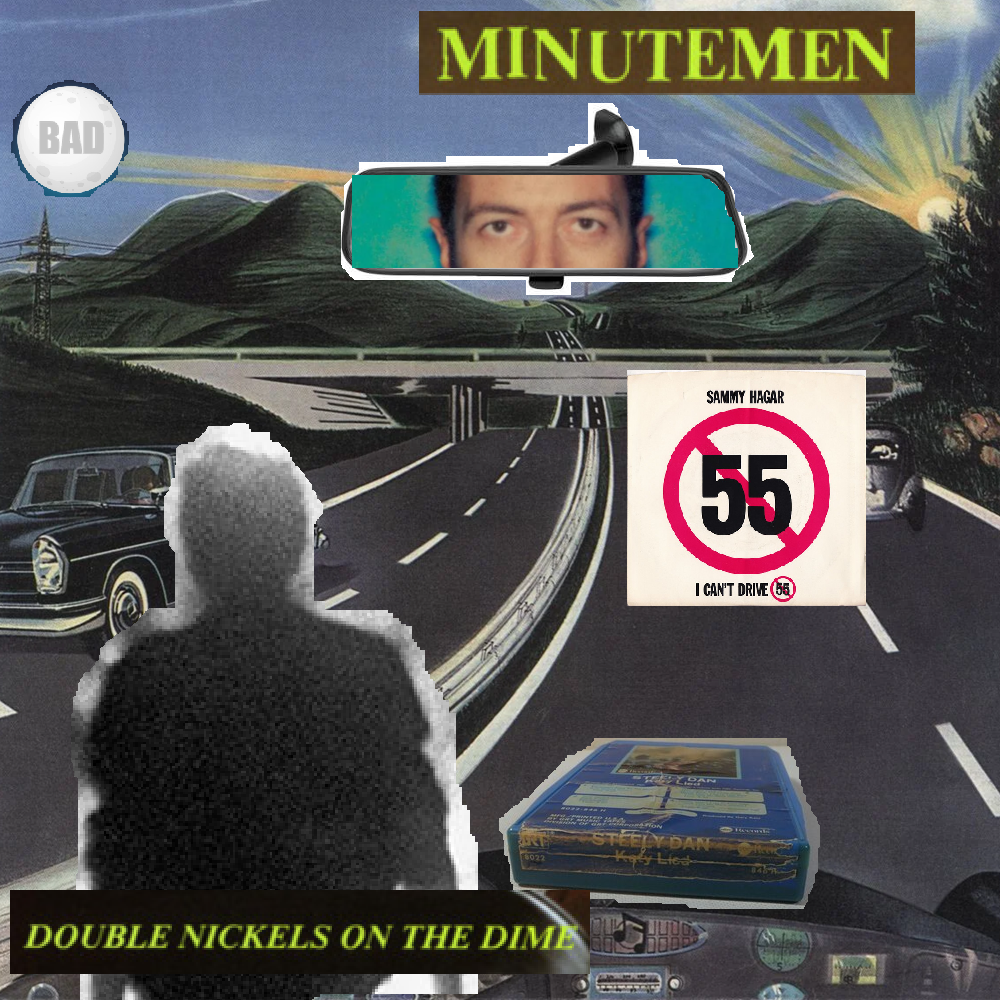
I suspect there are multiple flavors of completist. Some love the thrill of the hunt. Others may be driven by insecurity: a hidden force constantly tugging at their sleeve, reminding them that there’s still work to be done. And of course, there’s simple FOMO. What if the piece you’re missing just happens to be the best one, the very best piece of them all?
I’m not sure what kind of completist I am. In fact, I’m not even sure I’m a completist at all. All I know is one day about ten years ago I discovered that the CD version of the Minutemen’s landmark double album Double Nickels on the Dime – a CD I owned, that I knew and loved and trusted was exactly the version the Minutemen wanted me to hear – was incomplete, and I could not let that stand.
Okay, the backstory… I love classic punk but as somebody born fifteen months after The Year That Punk Broke, I had to discover many of my favorite albums long after they were released. As I worked my way through the classics–the Buzzcocks, Black Flag, Bad Brains, and several other bands that don’t start with B–one band remained adrift on the periphery: the Minutemen. I didn’t really know anything about them other than the fact that they and Husker Du had both released double albums in the same year. I had bought Zen Arcade in college but it didn’t really click with me (don’t worry, dear reader, it did eventually) so perhaps that discouraged me from taking a chance on Double Nickels on the Dime in an era where “taking a chance” meant “dropping $15 on a CD you might end up not liking.”
Thankfully for anybody not named Lars Ulrich, file-sharing hit the scene when I was in college, and then in grad school I hit the bigtime: an office with a high-speed internet connection. Of course the Minutemen were not being featured on TRL in 2002 so I was only able to download a handful of their songs. If I recall correctly, “Political Song For Michael Jackson to Sing” was one. I may be wrong on the specific track but I 100% remember thinking that I’d never heard punk like this before. (Scratch that: was it even punk? D. Boon’s guitar was all treble. Mike Watt’s bass was also all treble–as treble as a bass can be, at least–and seemed to carry the melody at times. Was George Hurley a jazz drummer? None of this seemed to make sense but yet it worked. Dear god did it work.)
So of course I was now ready to drop $15 on the CD release of Double Nickels. Despite being a double album it was pressed on a single CD, and this didn’t strike me as unusual. After all, an LP could hold about 44 minutes of music max and a CD could hold over 70 minutes. Zen Arcade was a single disc. So was London Calling. In the case of Double Nickels, the 12-cm plastic disc coated in metal held 73 minutes and change and I devoured every one of those minutes. The working class anger of “This Ain’t No Picnic.” The disarming beauty and sincerity of “History Lesson – Part II” (I still tear up every time I listen to it). The catchiness of “Corona,” which of course I recognized as the theme song to Jackass even though I’d never watched Jackass. Wait, is that a Credence cover? AND a Steely Dan cover? Is this a fever dream?
Fast forward a few years and like many music lovers acquiescing to our new digital/streaming world but still seeking the tactile experience of physical media, I started to build a library of vinyl records. Sometime around 2010 I ordered Double Nickels the double-LP, and when it arrived I promptly put it on the turntable. Just like the CD, it kicked off with the familiar sound of D. Boon’s car starting. This is not listed as a separate track on vinyl; the opener according to the record sleeve is “Anxious Mofo,” the song that interrupts the engine revs with the thump of Mike Watt’s bass. On the CD it’s listed as “D.’s Car Jam.” I always assumed this was a tongue-in-cheek reference to the Clash song “Car Jamming,” and I still do, though I’ve never found confirmation from any members of the Minutemen. (Fast forward a few years more when I started to get into Krautrock and I would discover this is also a reference to Kraftwerk’s seminal Autobahn, as is the cover, but that deserves its own article.)
I didn’t notice anything different about the vinyl until the last of the double album’s four sides, known as Side Chaff. A quick digression for those of you unfamiliar with Double Nickels lore: the Minutemen sequenced the album by holding a draft (because: of course they did). The three Minutemen took turns picking the songs that would end up on Side D., Side Mike and Side George. The undrafted songs would then become Side Chaff, the last side of the album. Somehow Side Chaff still contains some of the album’s best songs. And it was during Side Chaff that I suddenly hear something unfamiliar, something that I know isn’t on the CD: D. Boon is screaming “LITTLE MAN WITH A GUN IN HIS HAND” over and over. An absolute banger of a song. An absolute banger of a song I had absolutely without question never heard before.
I immediately pull out my old CD and compare tracks with the vinyl and, I’ll be damned, not only is “Little Man With a Gun In His Hand” missing from the CD, but so are two more tracks: “Mr. Robot’s Holy Orders” and “Ain’t Talkin’ ‘Bout Love.” Yes the latter is a Van Halen cover. (In an odd twist of fate, the title “Double Nickels on the Dime”–a reference to driving exactly 55 miles per hour–was a response to Sammy Hagar’s “I Can’t Drive 55,” and a year after the album’s release Hagar would be asked to join Van Halen.) Only the Minutemen could cover CCR, Steely Dan and Van Halen on the same album AND have that album be not an odds and sods collection but rather one of the greatest punk albums–or dare I say greatest rock albums, genre be damned–ever.
Now there’s one other difference between the original vinyl and the CD that I should mention. You know the “car jam” I mentioned that kicks off the album? The CD starts with the aforementioned “D.’s Car Jam,” literally D. Boon’s car revving, and ends with “Three Car Jam” which is–you guessed it–all three band members’ cars revving at the same time. It’s as if the album starts with D. Boon pulling up to the turntable and ends with all three members driving away from your turntable and back to San Pedro. Appropriately for a vinyl pressing with four sides, the original 1984 release had each side start and end with a car jam featuring the engine of the car of the namesake of that side, with the exception of Side Chaff, which featured all three cars at once. Serving as bookends to each side of each disc, none of the car jams are listed as such in the track listing. They’re not songs and don’t need to be recognized as such; they’re just there.
By the time I discovered the discrepancy between the vinyl and the CD, I was primarily listening to music on mp3, so I figured all I had to do was hook up my turntable to my laptop and record those three missing tracks and–voila!–a complete version of Double Nickels for my listening pleasure. But the completist in me figured I might as well add all of the original car jams while I’m at it. Now this is where things get weird… My understanding was that each side of the album started and ended with a car jam, but when I went to transfer the car jams from vinyl to mp3, I noticed that there was no car jam at the end of Side D. and no car jam at the beginning OR ending of Side Mike. Had I been misinformed about the car jams?
I was tempted to order an original pressing to solve the mystery, but thankfully some kind soul on the internet had recorded each side of the original LP and uploaded it to YouTube. And much to my surprise, I discovered that my 2008 re-release pressing was indeed missing one car jam at the end of Side D. and both car jams from Side Mike.
Now I could sort of understand why the car jams were omitted on the CD re-release: in addition to taking up valuable time, they didn’t really work as bookends of the album’s four sides on a digital release that, well, didn’t have sides. But if you are re-releasing the album in the same format as the original, why wouldn’t you just copy the master exactly? What reason is there to cut one of D.’s car jams and both of Mike’s but leave both of George’s and both three-car jams? (Some people want to know who killed JFK. I want to know what happened to the car jams. We are not the same.)
In the end, thanks to the YouTube uploads, I was able to compile a near-perfect digital version of the original 1984 pressing. And when I listen to it, I think I get more excited about the car jams than I do about either “Mr. Robot’s Holy Orders” or “Ain’t Talkin’ ‘Bout Love.” (But NOT more excited than I get about “Little Man With A Gun In His Hand.” I told you that song rips.) But returning to the question of “what kind of completist am I?”: I find myself wondering why it was so important to add those final little bits to my nearly-complete CD? Especially the car jams. Why did I feel that a complete album was so much better, so much more valuable, that I spent my entire afternoon transferring the last missing pieces to mp3? Is it that the recording was imperfect without them? Is it the thrill of creating something nobody can buy? Or maybe just the satisfaction of knowing that nothing is missing, the knowledge that I can experience a thing fully itself and complete?
It may be a little of all of those things, but as I reflect on my project, it occurs to me that the biggest thing is this: it’s about hearing what the artist wanted me to hear. D. and Mike and George wanted me to hear them covering Van Halen in less than 40 seconds. They wanted me to hear the noodling of “Mr. Robot’s Holy Orders” and the rage of “Little Man With A Gun In His Hand.” And they wanted me to hear their cars. The Minutemen were gracious enough to share their art with me; the least I can do is enjoy it as they intended.
When he isn’t listening to music, playing music, or in this case writing about music, Russ Chibe manages life science and telehealth risks for a speciality insurance company. You can read his thoughts on music, sports, and the decline of Western civilization (the actual decline, not the documentary, though he does love the documentary for the record) on Bluesky at @bvrlytweetmaker.bsky.social.And if you’re really lucky, you can catch Russ playing keyboards and bass–but not at the same time–for the best country-tinged bar band in the greater Chicagoland area, the Sidecars.