
On Peter Gabriel's "Melt" and Steve Biko
Published on Feb 21, 2026
Be Sure to Wear Flowers in Your Hair
Published on Jan 19, 2026
WALK OUT TO WINTER: falling in love with—and to—Aztec Camera's High Land, Hard Rain
Published on Dec 26, 2025
First Anniversary
Published on Dec 17, 2025
More Liner Notes…
Featured Essay: Easy Livin'
by Vic Larson
My first vinyl album was a gift given to me during the early 1960s. Meet the Beatles in 1964 was a virtually inescapable presence in department stores of the day. Beatlemania was so ubiquitous it captured the imagination of all ages, especially when Ed Sullivan deemed the act worthy of his show’s precious air time, broadcast into our homes on February 9th that year.
My parents were people of meager means. Our family of four lived in one thousand humble square feet in a Chicago suburb called Park Ridge. We had one moderately reliable car for use by Mom. Dad walked a half mile to the Chicago & Northwestern train station to head into the city for work, no matter the weather.
Mom and Dad grinned when they returned home from shopping at Montgomery Ward one Saturday afternoon. Dad always called the store “Monkey Wards,” as did many others. He handed me a paper bag, and stood back as if waiting for an explosion. I guess I looked puzzled, looking from them to the bag and back again.
“Go ahead, shake it,” said Dad.
Was it alive? A surprise like this was entirely out of character, I imagine Mom twisted Dad’s arm a bit to fork out four dollars, but by this point he seemed an eager participant in the performance. I was delighted when I slid the now iconic image of the Fab Four from the brown bag, and wouldn’t be surprised if they sat in the next room when I ran to drop the needle for a listen.
I still have that record, and like others that followed in my early foray into the world of pop music, it was a monaural recording. We had our choice in those days. Stereo records required, well, a stereo, and came at a slightly higher cost. The record playing device I inherited from an older sister was little more than a stiff laminated cardboard box. It had a rotating platter, one speaker and a volume knob.
Industrious lad that I was, I soon dismantled the record player, cut the connection to the speaker and spliced in two sets of speaker wires, each fed through holes I drilled in opposite sides of the box that held everything together. It was still a mono machine, but the sound was dispersed across my bedroom in a very stereo-looking manner to two small external wooden speakers. What I needed next was, more albums. A real stereo would come much later.
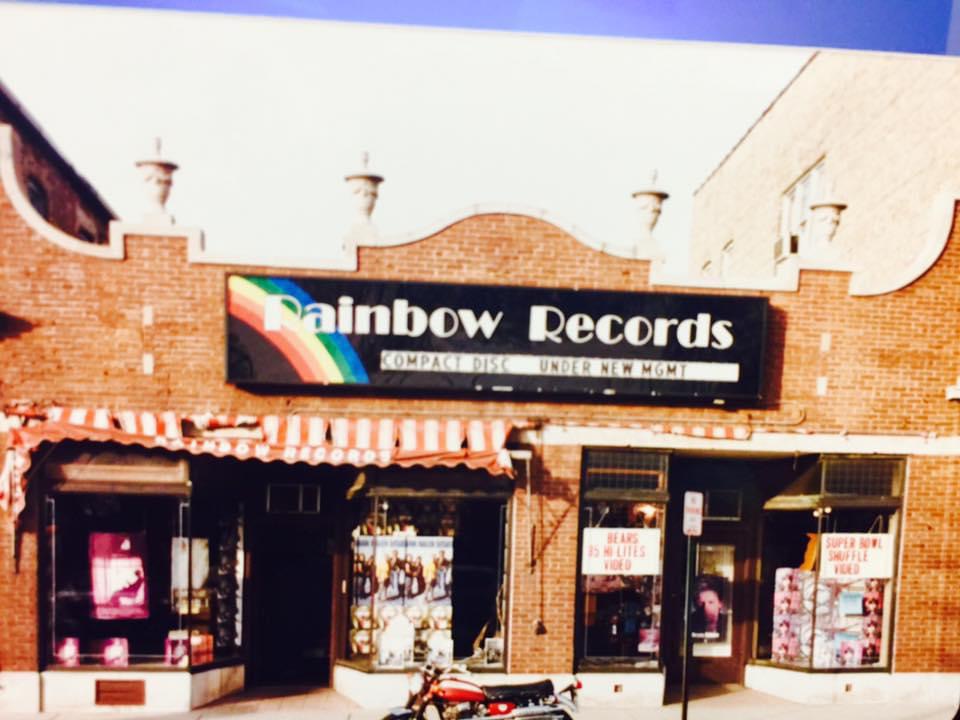
One of my favorite places in Park Ridge was Rainbow Records. During its heyday in the 1970s and ‘80s it was about three miles from my home, located in the city’s shopping district across from the train station my dad passed by twice daily. I rode there on my bike, down streets with very little traffic, and as long as the weather permitted.
I didn’t have much money as a kid. I was given an allowance of fifty cents per week and was expected to do chores or mow lawns if I wanted more. But in those days, a frugal youngster could amass the small fortune necessary to buy a vinyl record album. And yes, I realize how much this paragraph gives away my advanced age.
Inside the shop were rows and rows of crudely constructed wooden bins, packed with colorful albums, arranged alphabetically and by genre. I always went straight to the Rock and Folk sections, and on the day I’m describing here, to the letter “U.”
Ordinarily I was there to buy the latest yearned-for album, often by Cat Stevens, James Taylor, Simon and Garfunkel or Chicago. But as my musical tastes broadened during that memorable decade, I found myself lusting after one song included on an album by the British band Uriah Heep. The song was called Easy Livin’. It was common to buy an entire album in order to own a copy of one favorite song.
I now know that Uriah Heep was a sinister character created by Charles Dickens for his book David Copperfield, but that didn’t matter to me at the time.
Today I would simply ask Alexa to play this tune on Amazon or Spotify, at any time and from any location in my house where an Echo device is handy. A Bluetooth connection to a Bose speaker out on my patio takes the listening experience to a higher level. But not so back in the 1970s. I had to carefully tuck the wind-catching flat album under my arm and pedal three more miles home to enjoy some new music.
I gently split the cellophane wrapper on the cardboard outer album cover and slid the protective inner paper sleeve out to examine the record. The album cover was right – Demons and Wizards - but the album itself was wrong. There, instead of Uriah Heep, was a different disc by Siouxie and the Banshees, 1978’s The Scream. I had never heard of them, unaware that they were influential post-punk pioneers, and was utterly disappointed to have made the six-mile round-trip by bike only to wind up with the wrong product. Of course, with youthful energy I headed back, and the clerk graciously replaced my selection with the correct one.
I enjoyed spending time at Rainbow Records, perusing the endless displays of all the latest music. The air hung heavy with the distinctive sweet and musky smell of patchouli, a visceral association I have carried with me throughout my life. With eyes closed, that incense takes me directly back to the record bins at Rainbow.
And long after Rainbow left Park Ridge, I still find comfort thinking about the time I spent there shopping for records, when an album full of songs cost only four dollars, and when artists of the day formed the framework of my life’s musical soundtrack.
Vic Larson was a senior writer in a Fortune 100 company near Chicago. His work has appeared in numerous national and international literary journals. He won the 2021 Gulf Coast Writers Association fiction contest. His fiction anthology Natural Selections and two-volume memoir, Park Ridge Memories are available on Amazon (here). You can find out more about Vic on his Amazon author page.