
On Peter Gabriel's "Melt" and Steve Biko
Published on Feb 21, 2026
Be Sure to Wear Flowers in Your Hair
Published on Jan 19, 2026
WALK OUT TO WINTER: falling in love with—and to—Aztec Camera's High Land, Hard Rain
Published on Dec 26, 2025
First Anniversary
Published on Dec 17, 2025
More Liner Notes…
Featured Essay: Eric Blake's Sin City and the Anti-Algorithm
by Matthew Rothstein
I spent a good portion of my adult life knowing that picking up a vinyl collecting habit was just about as dangerous to me financially as a drug or gambling habit.
To defend against this peril, I never purchased a record player, even as the reality sank in that every part of the digital media landscape is vulnerable to corruption, usurpation and destruction by the massive forces of capital that sit atop it. My lovely partner, who has a formidable eye for gift-giving, noticed my feeble act of resistance and crushed it by buying me a refurbished record player for Hanukkah this past winter.
Within a month I owned dozens of records, and not even losing a job in the spring and unemployment this summer could keep that number from climbing into the hundreds. I always knew it would come to this, and now it has, so I turned into the skid. Now, I’m a full-throated evangelist for physical media and a grubby-fingered treasure hunter for used records.
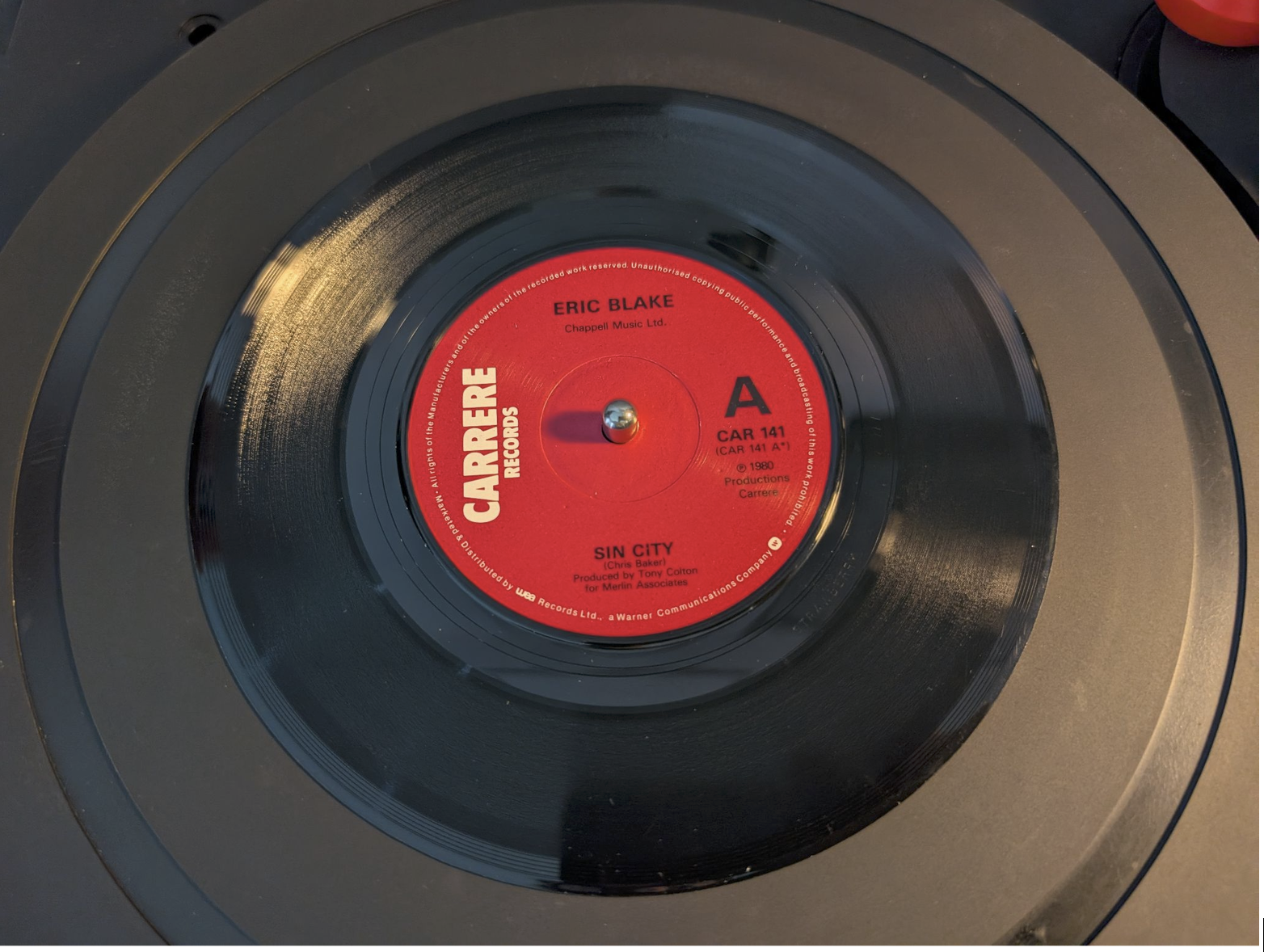
So far, the greatest treasure I’ve found is “Sin City,” the A-side of a 45 from Carrere Records by Eric Blake. Though there are plenty of solo artists on the internet named Eric Blake, this was the cheeky name of a seemingly short-lived band from the Essex area of England. Their entire internet footprint is contained within a couple of Discogs listings and some posts from the golden age of mp3 blogs (2008-2010), an anarchic moment in time I will hold in nostalgic glow forever.
Those sources seem to agree on basic facts, such as: The band was fronted by singer Julie Harding, who was 17 at the time “Sin City” was released. She was joined by Mick Fanning and Rob Timms on guitar, Alan Baker on bass and Bob Harding on drums. Chris Baker, a pop-rock singer/songwriter from the UK who also has little online footprint, bears the writing credits.
Right from the first bars of “Sin City,” Eric Blake proudly wears the influence of early Jamaican ska and reggae — a crucial piece of British punk and post-punk’s DNA from the beginning. A toylike keyboard line welcomes the listener, before Harding and the backing band lay down a minimalist first verse redolent of the Lovers Rock subgenre of reggae that flourished in the Caribbean diaspora of the U.K. at around this time.
And with a sudden crescendo that would make Phil Spector chuckle, the chorus explodes in a burst of power-pop color, with multilayered vocal harmonies evoking doo-wop and Motown as much as Jamaica. Even though the sound expands from music box to concert hall in scale, “Sin City” proceeds at a languid pace.
The lead guitar has a sheen akin to the biggest, broadest AOR like “More Than A Feeling,” and when it bursts skyward for its solo in the back half of the song, I almost started to ask myself if I like piña coladas and getting caught in the rain. But the rhythm section gently nudges things along, nestling the dad rock component snugly alongside the girl group vocals. It’s a sunbeam of a song.
***************************
I’m a burrower by nature. When a new artist or song (or in broader terms, when any piece of media or area of interest gives me that juice), I dig. I’ll listen not just again, but louder, in more immersive formats; perhaps do some reading into its backstory; scratch around for any connected or related artists who might rub that new little spot on my brain the same way; and savor it for a little while. I seek new places to burrow frequently, making myself a network of warrens to dip into intermittently as time goes on.
I’m aware it’s not a major revelation that a music nerd often needs a fix of something new, or at least something different, but as a true-blue millennial who came of age at the dawn of Napster — and moved through Kazaa, Limewire, torrenting, Shakespeer and finally streaming services like a nomadic tribe following a large animal herd — I have spent a long time learning the difference between hearing a song a lot and burrowing into it.
Physical media, but especially vinyl, with its liner notes and its deep, imperfectly preserved history, is for the burrowers. There’s nothing so satisfyingly anti-algorithm as grabbing a handful of 45s by artists you’ve never heard of from an unsorted cardboard box shoved into the corner of a local record store.
The thrill of discovery — and the lack of initial context — has a way of softening my judgmental tendencies. I’m less confident that I know the next thing I’m going to hear, and that makes me more forgiving upon my first listen than I am when someone pops on an algorithmic Spotify mix to fill some silence. By this point, when I’m watching a TV show made for a streaming service in the past five years, my hackles are ready to be raised at any signifiers of content designed to be a second screen, unobtrusive, rather than interesting.
I’m just as vulnerable as the next avid listener to the charms of being able to call up music from seemingly any country, any genre, any era instantaneously; I avail myself of it every day. But just as the video streaming era has resulted in a handful of giant entities drawing customers in with deep libraries, then tossing huge chunks of their libraries out the window in favor of cheap, new slop, the illusion of having all the options is a corrupting influence.
(This goes deeper than just in our media intake, but a key element of enshittification is trying to erase the audience’s memory of the things they used to like better by giving them a bunch of options meant to kind of resemble the vague feeling that they’re chasing. The forces of capital perched atop the media landscape want you to stop using your executive function to find cool shit! They want you to have less and less patience for not liking stuff or not being sure how you feel about something the first time you hear or watch it! Don’t fall for it!)
Even if I like an algorithmically suggested song, giving those services any information on my preferences nudges every subsequent suggestion in that direction, all but ensuring that I’ll feel sick of it if I don’t take active steps to mitigate the process. I have very little ability to preserve any sense of magic in that environment.
Infusing objects and moments with such emotional power has risks. The lure of nostalgia can trap certain kinds of nerds in battles over intellectual property and media adaptations for the sake of protecting those treasured spaces in their memories. Short of that, having such a moment with a song inevitably increases the urge to chase the feeling anew, with more records.
But I’d argue the act of caring about the thing — of going and finding it and sharing it person-to-person — is a crucial counterweight to the more toxic side of compulsive or addictive behavior. I also have a stable romantic relationship and professional mental health treatment to thank for helping me build a stable base for my personality. With that, the desire to share and to show others the treasures I’ve found makes me feel much less like a frenzied burrower and more like a …cool…guy?
It is a blessing that it took until I was into my late thirties for me to be drawn into the world of vinyl. This is true for many reasons, of course, but most of all that I didn’t pick up the habit until I had been in therapy for years and found myself in a healthy, long-term relationship.
I can, as clear as a bell, envision a version of me hunched and sweating over a crate of used records, stuffing disc after disc into my bag that I know I can’t afford because I came to this record store on an impulse, pulse racing, while avoiding a work task or to-do list. At least now, I can see that vision and calmly observe it as if separated by aquarium glass. Or just moan to my fiancée that I wish I had the money to buy records and move on with my day.
***************************
Compared to most songs that have hit me like a bolt from the blue, the rabbit hole for “Sin City” wasn’t very deep. The B-side of the record, a punkier, bouncier number called “Zero 6,” is worth a listen as well, and I’ll be on the lookout for a copy of Eric Blake’s other single, “80’s Girl.” But even that lack of information makes “Sin City” occupy a much more pleasing piece of mental real estate than a song an algorithm pops into my queue when I’m not paying attention.
Without much of a story to keep uncovering or more threads to pull, now “Sin City” is a place to return to, like a secret swimming hole one can’t wait to show their closest friends — the ones that can be trusted with special things.
Matthew Rothstein is a freelance writer, reporter, copywriter and editor living in Philadelphia. Follow him on Bluesky @mattrothstein.bluesky.com to find out when his work starts to pop up in other places.