

On Peter Gabriel's "Melt" and Steve Biko
Published on Feb 21, 2026
Be Sure to Wear Flowers in Your Hair
Published on Jan 19, 2026
WALK OUT TO WINTER: falling in love with—and to—Aztec Camera's High Land, Hard Rain
Published on Dec 26, 2025
First Anniversary
Published on Dec 17, 2025
More Liner Notes…
Featured Essay: Experiencing Rush through Vinyl
by Sarah Bala
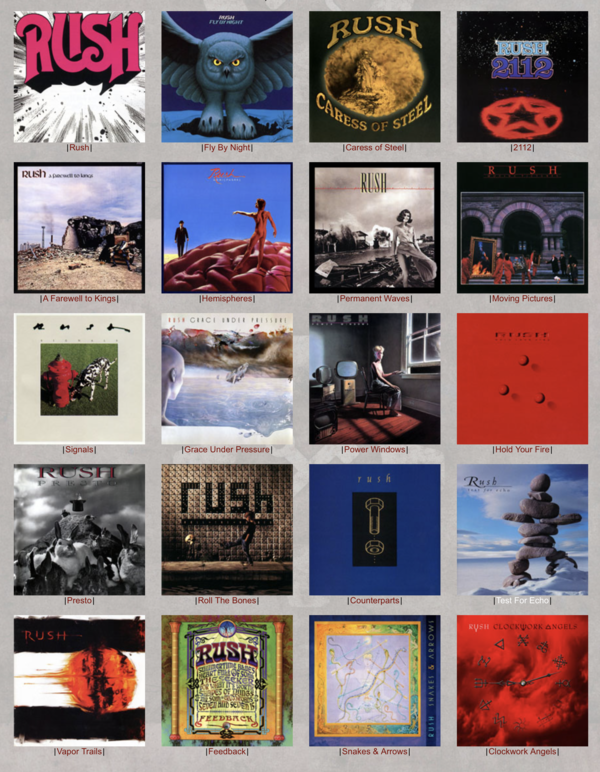
In July of 2026, I will be attending my first Rush concert.
To say I am excited is the understatement of the century. The Canadian progressive-rock trio, Rush, is my favorite band. And it was my exposure to their music through vinyl records where I fell in love with the music.
Because the music spoke to me. It is what happens when living, breathing people come together and create music they want to listen to and create. Rush is in a league of their own. These are three guys, Geddy Lee, Alex Lifeson, and Neil Peart,who were able to craft a symphony from rock music. And while I enjoyed Rush’s music for years before collecting their music on vinyl, there was something special that formed when I began listening to the discography on vinyl.
My adventures in acquiring this collection of Rush’s vinyl discography began in December of 2019 and it changed who I am and how I relate and listen to music. So come with me as I explore some of my vinyl highlights, listed chronologically in the order they were bought.
Signals, 1982
December 2019. I am at a Christmas market in an old theater in Downtown Los Angeles. After scoring a rad $40 leather jacket, I notice the cover of Rush’s 1982 Signals at the front of a record bin. I liked Rush for a lot of their older guitar-based records such as 2112 or even Moving Pictures, but I knew Signals was the introduction of their synth era.
Curious, I turned the record over to find a huge coffee stain, but looking at the vinyl record itself, the condition was pristine.
When I got home that afternoon, I immediately put on the record. The opening synth line of “Subdivisions” thumps through the speaker. It’s one of my favorite opening lines on any album. Not only is the line attention-grabbing and catchy, but it is symbolic of a new artistic voice for Rush. “Subdivisions” begins a song whose subject matter is very prescient to myself and others- the feeling of not belonging in a world not made for you yet wanting more from life..
This was the album where I called myself a Rush fan for the first time. To this day, every time I look at the cover and turn it over to see the same coffee stain, I am transported to that old theater in Downtown LA.
Grace Under Pressure, 1984
Rush drummer Neil Peart died in January 2020. As someone who was really getting into Rush’s discography at the time, it felt like the rug was pulled out from under me. When the music felt so alive, how could one of them just die?
Music means a lot to me. And when the person who made some of my favorite music dies, there is this inexplicable hollow feeling. About a week or two after Neil’s death, I decided to visit the Record Parlour in Hollywood and see if they had any Rush records. And while I was hoping for a ubiquitous Rush record like 2112 or Hemispheres, the only Rush album they had in stock was 1984 Grace Under Pressure. If I thought that Signals was synth-heavy, Grace Under Pressure was about to prove me wrong.
Sure, it wasn’t 2112. But it was an original US pressing of a Rush album in great condition. And while skeptical at first, I came to love Grace Under Pressure. Due to the album’s strong point of view and poetic lyrics, I still find something new after every listen. Yes, many of the album’s songs detail the contemporary feelings of the late Cold War and Reagan Era. But the criticism of the Cold War binary, good vs evil mindset remains incredibly modern.
I also love the production on this album. Rush really took a risk in bringing in a new producer, Peter Hendserson, for this album instead of their longtime collaborator, Terry Brown. Henderson brings a refreshing perspective to Grace Under Pressure.
And did I mention that I firmly believe that the album’s opening track, “Distant Early Warning” is a solid dance track? Because I certainly think so.
Permanent Waves, 1980
I can’t even tell you when I bought Permanent Waves, but it was at a time deep into the trenches of the pandemic. My mom found a record store and we were allowed in one at a time. But I got what I wanted- a quality, 1980 US pressing of Permanent Waves.
While Permanent Waves is not my favorite Rush album, it does contain two of my favorite Rush songs: “The Spirit of Radio”and Natural Science.” “The Spirit of Radio” showcases how Rush can operate more like an orchestra than a three-piece band. Alex’s memorable opening riff establishes the boundless energy of the song. Then, together, a simple synth line behind Neil’s pounding drums and Geddy’s bass groove makes the record come to life. The song settles, beginning a roller coaster of anticipation and payoff while maintaining incredible musical hooks.
The album ends with a nine minute progressive rock anthem, “Natural Science,” that is so cool and so good. The band really takes advantage of ⅞ and Neil Peart is at his best on this track. His drums are just so powerful. I also love the lyrics. It’s a skeptical yet ultimately optimistic perspective on the triumph of artistic freedom and expression.
Moving Pictures, 1981
Rush’s masterpiece. The perfect blend between musical complexity and popular accessibility. The record begins with Rush’s most popular song “Tom Sawyer.” On every listen, Neil’s iconic drumming on this song vibrates the floor. You can feel his attack on every beat- it’s so clean yet so energetic and raw.
And of course, there’s Alex Lifeson’s solo in “Limelight.” Hearing one of the greatest guitar solos on vinyl from its original pressing is truly an experience. It’s why I love Alex’s playing so much- he has a deep understanding of the guitar and melody to innovate on the instrument while creating memorable earworms.
Lately, I’ve been obsessed with the B side of this album. There’s something about the grand synth line in “Witch Hunt” over the final verse that can still move me to tears:
Quick to judge, quick to anger
Slow to understand
Ignorance and prejudice
And fear, walk hand in hand
Hemispheres, picture disc,1978
Hemispheres is my favorite Rush album. It’s so gutsy in its attempt and the execution is fantastic. The precision is intense, the artistic voice is clear. I love this album so much.
And while I eventually obtained a 1978 US pressing of the record, originally I bought the mint-condition picture disc.. On the picture disc, the album artwork is on the physical vinyl record. It’s something I have for the novelty and to showcase my love for the band and Hemispheres. There are mixed reviews on the audio quality of picture discs, but they sure do look cool.
Rush Live!, 1981
Here is another cool pandemic find from the Record Parlour in Hollywood. It was a promotional record for three songs off of the band’s then upcoming live album, Exit Stage Left. Unlike the Hemispheres picture disc, I actually play this record. But like the Hemispheres picture disc, it is more of a collectible. A fun Rush rare find to show off. While I love owning artist discographies of studio records, there is always a record out there to peak my interest that you cannot find on streaming.
Exit Stage Left, 1981
The ultimate Rush live album. The band is at an obvious high after completing Moving Pictures. The performances are phenomenal. With Exit Stage Left, I am transported to a 1981 Rush concert. The gorgeous album cover depicts a woman pushing the curtain to reveal an excited audience. It’s the type of live album I show when someone asks why I love Rush so much.
I also think it showcases the glaring audio differences between vinyl records and streaming. The sound is a lot more thin on streaming, highlighting the deficiencies of songs from streaming services.
For years, I didn’t see the benefit to live albums, but I have since been proven very wrong. Besides, Exit Stage Left is the closest I will get to a Rush concert. Until July.
Rush is a fifty-something year old band. Their records, chronologically, are old. But at the end of the day, their connection to music and artistry is timeless. There will always be people who dedicate themselves to musical creation and pushing boundaries. My Rush record collection is a footnote in that tradition.
Man, I can’t wait to see them in concert this July.
Sarah is a writer living in Chicago. When she’s not listening to music or furiously down ideas in 10 different notebooks, you can find her singing, playing piano, researching her ancestors, or hanging around the Chicago comedy scene. She has previously written about travel, music, and her genealogy work. In July 2026, Sarah will attend her first Rush concert.