

On Peter Gabriel's "Melt" and Steve Biko
Published on Feb 21, 2026
Be Sure to Wear Flowers in Your Hair
Published on Jan 19, 2026
WALK OUT TO WINTER: falling in love with—and to—Aztec Camera's High Land, Hard Rain
Published on Dec 26, 2025
First Anniversary
Published on Dec 17, 2025
More Liner Notes…
Featured Essay: Gene Joins the Band – The Dave Brubeck Quartet in Europe
by Tim Foley (aka T.J. Wolfsbane)
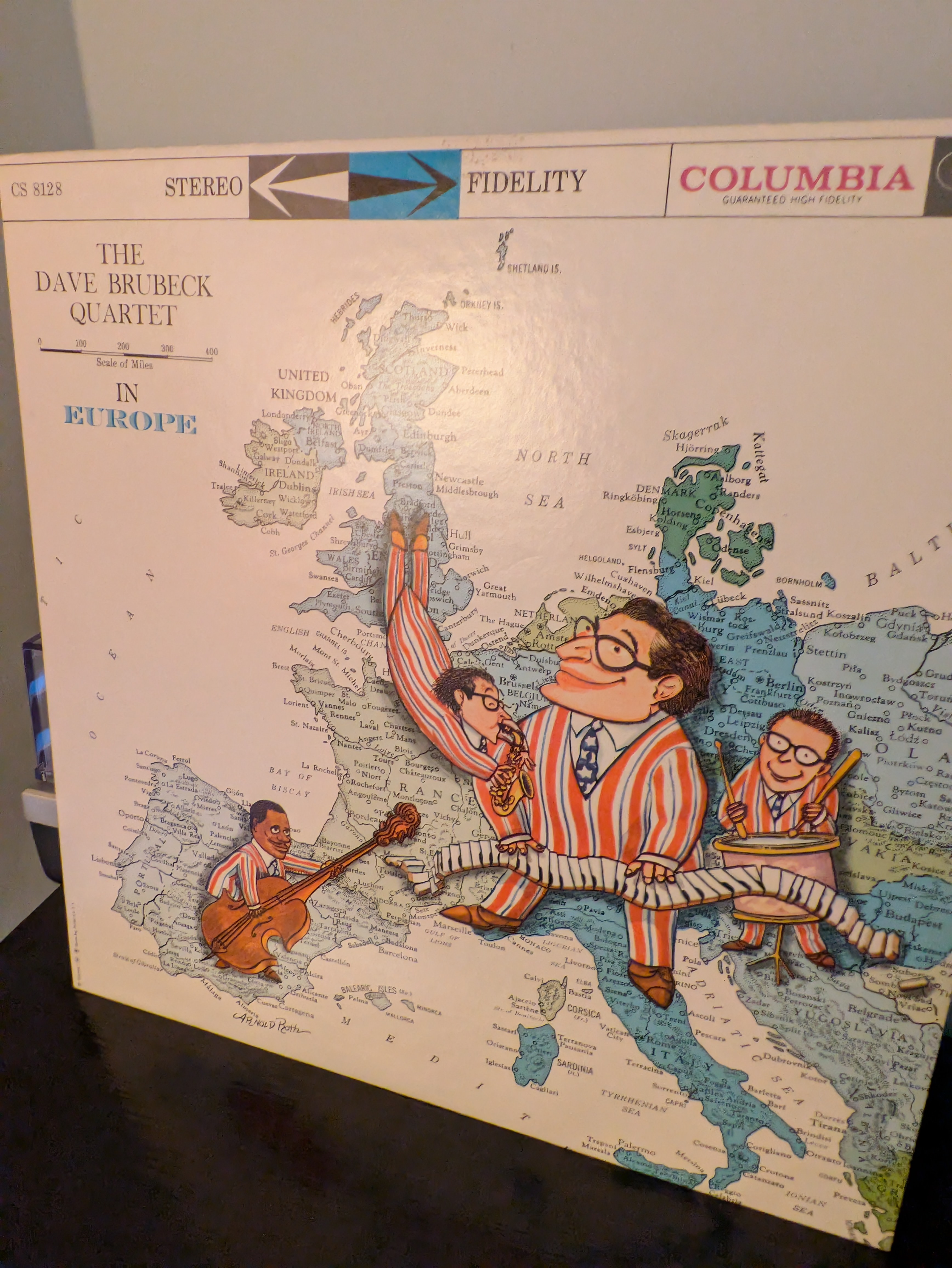
My grandfather’s brother David was born, raised, and lived out his life in Buffalo, New York. A prizefighter in his younger days, a confirmed bachelor drifting through life, he enjoyed the nightlife and loved jazz. I never met him; he died young. Somehow, I ended up with his vinyl, or at least some of it: Duke Ellington, Coleman Hawkins, George Shearing, and others. One of my favorites is a rather obscure Dave Brubeck Quartet album, a recording of a concert performed in Copenhagen in the spring of 1958 released on Columbia as The Dave Brubeck Quartet in Europe.
In the mid-50’s, Columbia ignored the burgeoning rock ‘n’ roll market and instead signed a number of jazz luminaries, including Ellington, Louis Armstrong, a young Miles Davis, and Brubeck. The label was demanding, expecting the artists to deliver two or three LPs a year while touring to support the releases. In 1954, the Brubeck Quartet, featuring Brubeck’s piano and Paul Desmond’s saxophone, spent months performing at colleges, a savvy move targeting young fans, and released a breakthrough collection of live performances entitled Jazz Goes to College. Four years later, due partly to that success, Dave Brubeck found himself recruited by the United States government – they did that type of thing in those days – for a worldwide tour promoting American jazz artists, winding through Europe and then heading to the Middle East and Asia. After all, what better way to defeat communism than presenting magnificently talented American musicians and selling lots of records overseas.
Brubeck agreed to the tour; Desmond and drummer Joe Morello were game. One problem: bass player Norman Bates (yes, that was his actual name, before Psycho) did not relish leaving his family for four months. Brother Bob Bates, also a bass player who frequently played with Brubeck, was committed to other projects. So they turned to Gene Wright, a Chicago-bred talent who played with Count Basie, to round out the quartet. As it turned out, the result was magic.
The album culls six pieces from the Copenhagen show. Side one begins, a wink at the audience, with a heavily improvised version of “Wonderful Copenhagen.” According to Brubeck, they had only rehearsed the song once before the show. Brubeck’s thoughtful, sensitive “My One Bad Habit is Falling in Love” follows. Wright’s status is shown by the inclusion of his own composition “The Wright Groove,” featuring his wizard-like skills on the bass. Joe Morello delivers a lengthy, mesmerizing solo on “Watusi Drums” and Desmond’s technique is never more gorgeous than it is on “Like Someone in Love.” The pick of the tracks, though, is the lengthy, daring and slightly dissonant “Tangerine,” anchored by Desmond, but with each member of the quartet making a superb contribution.
Regretfully, the album suffers from the sonic limitations of the equipment of the time. It is an early true stereo release, at a time when mono was still the norm, and the mix is less than ideal. While Desmond’s sax is sharp, Brubeck’s piano is muddy, and Wright’s bass is frustratingly soft. Still, the performances feel fresh and daring, the musicians playing off each other like the pros they were. The rapt audience politely applauds the solos, then goes crazy when a song ends.
The real significance of this album, though, is its place in jazz history. It captures a performance of the Quartet during that legendary tour. The weeks of playing nightly and the hectic gig-packed hothouse of the tour resulted in a unique, truly special energy among these four men. Wright and Morello provided a foundation – sometimes driving, sometimes flowing – that buoyed Desmond and Brubeck, then would step up for their own stunning solos. During the tour, the musicians began to look for new challenges, their ears attuned to different approaches to rhythm and melody that they encountered along the way. Brubeck came up with an idea: instead of the even, standard, mid-tempo 4/4 pace of so many jazz records, he wanted to record an album of songs that used unique and unusual time signatures. After all, he had Gene Wright on bass and Joe Morello on drums, two guys who could play damn near anything.
Thus, in the summer of 1959, after finally convincing the folks at Columbia, these four masters, each at the peak of their powers, would gather for three days in New York and record the brilliant, experimental Time Out, with the groundbreaking tracks “Take Five” and “Blue Rondo a la Turk,” a masterstroke that became the best selling jazz record in history (at the time) and the first jazz LP to sell a million copies. I’m willing to bet that my great Uncle David wore that album out, and he wasn’t the only one.
Tim Foley is a writer and playwright, living in Sacramento. His collection of ghost stories, Tales Nocturnal, was issued by PS Publishing in 2025. Long ago, he played guitar for a few Bay Area bands and, even longer ago, he was the music director of an FM radio station. His website: www.TimothyJFoley.com