
On Peter Gabriel's "Melt" and Steve Biko
Published on Feb 21, 2026
Be Sure to Wear Flowers in Your Hair
Published on Jan 19, 2026
WALK OUT TO WINTER: falling in love with—and to—Aztec Camera's High Land, Hard Rain
Published on Dec 26, 2025
First Anniversary
Published on Dec 17, 2025
More Liner Notes…
Featured Essay: Is It in My Head? Dissociative Identity, Plurality & Quadrophenia
by Ceej Wolf
Written in the United Kingdom on March 17th, 2026
CW: mentions of self harm, suicidal ideation, depression, discussion of identity disorders. Spoilers for The Who’s Quadrophenia (both the record and film) throughout.
It’s sometime in fall 2015. A teen is standing along a reservoir dam a bike ride away from their house. They’ve got a journal full of poems about the guy in Germany they’re in love with. The twilight shines over the water, gloom hiding in the shadows. In just a few months they’ll be back here with a bottle of sleeping pills in their hand, trying to keep their balance as they walk along the reservoir dam edge. This was their sea. They wanted to take their own life. For now, they pick up their mountain bike and set off north into the endless trails of the forest. “Can you see the real me?”
I first discovered The Who after being exposed to Pink Floyd’s rock opera The Wall, which then led me to discover The Who’s rock operas. I must have been 13 when I first heard The Wall.To say it totally changed the way I thought about music and art would be an understatement. It was introspective, it was larger-than-life; The Wall was conveying a narrative I never realized the genre of rock music could achieve. Quickly after listening to The Wall,I sought out the DVD copy of the film adaptation at my local record shop. Roger Waters’ brutal takedown of not only himself but the music industry that Pink Floyd interfaced with was masterful. You heard murmurings of it on a song like Welcome to the Machine, you realized Pink Floyd’s true political stances on a record like Animals and now you’ve arrived at the peak, frightening satire of what record labels wanted to make out of artists. I had difficulty relating to the main character, Pink, as an early teen. I had no trouble relating to the themes of isolation in The Wall, but I could never fully connect with its main character. It wouldn’t be until a year or so later that I would find Quadrophenia, and in it a main character that I could relate to. Someone who just wanted to belong in this world. Someone who struggled to keep personalities in order. “The heat is rising, the past is calling”.
My teenage years were lonely and volatile. I had indulged in self destructive behavior, self harm and had gotten myself into some rather unsavory online relationships. I had very few friends, but I didn’t mind. I had an iPod full of records and a makeshift drum practice space in my parent’s unfinished basement. But something was missing. Belonging, community, relationships- things that “would give my life meaning”. The primary struggle I had at this period in my life was dissociative identity disorder, very similar to the disorder Jimmy in Quadrophenia has.Like myself, Jimmy had trouble fitting in with his culture. Unlike myself, he was eventually swept up by the mod culture of the 1960’s in England. This was an aimless generation defined by style, rhythm & blues and rowdiness. Proto-punks that could not fit the mold that the generation before them created. All odds stacked against them from birth. But they still wanted to belong in some capacity, almost to a fault.
“Why should I care if I have to / Cut my hair? / I’ve got to move with the fashion, or be outcast”
As the fourth track Cut My Hair decrees, the mods in Quadrophenia’s universe set social expectations for each other. You have to dress a certain way. You have to listen to certain music. Quadrophenia’s observation of mod culture is more like a clique than a community. I can draw many parallels between the mod culture painted in Quadrophenia to the queer culture I’ve been in my whole life, however for the sake of focus we will mainly be talking about how Jimmy’s identity disorder helped me come to terms with my own.
The name “quadrophenia” partly comes from the new technology that allowed four speakers to be tied together to create a quadrophonic image (a predecessor to 5.1 surround sound). Pete Townsend combined the words “quadrophonic” and “schizophrenia” to make the album title’s portmanteau- quadrophenia. Jimmy is portrayed as a schizophrenic depressive in both the record and subsequent film adaptation. I can’t speak for Quadrophenia’s portrayal of schizophrenia, but what I can speak for is how dissociative identity disorder (DID) is conveyed as a plot device, metaphor and ultimately a statement on subculture.
*Quadrophenia* avoids feeling like a Pete Townsend project more than a Who project, something I appreciate compared to *The Wall*. *The Wall* had Roger Waters’ all-encompassing vision, while Pete’s approach (a meta inclusion of The Who’s other members) prove to be one of the strongest aspects of the record. Roger Daltrey, John Entwhistle and Keith Moon’s contributions were not just in the performances on this record, but also in their leitmotifs. Each band member makes up a different part of Jimmy, a composite of a very confused individual seeking purpose in his young adult life. The themes of each member are as follows:
Bell Boy – Keith Moon
Helpless Dancer – Roger Daltrey
Is It Me? – John Entwhistle
Love Reign O’er Me – Pete Townsend
The record is very explicit that Jimmy is broken into four distinct personalities. Four different alters complete with different desires, all clashing due to their individual wants and needs not being met. All four personalities are stuck in a very lonely and volatile system, stuck between conformity and individualism.
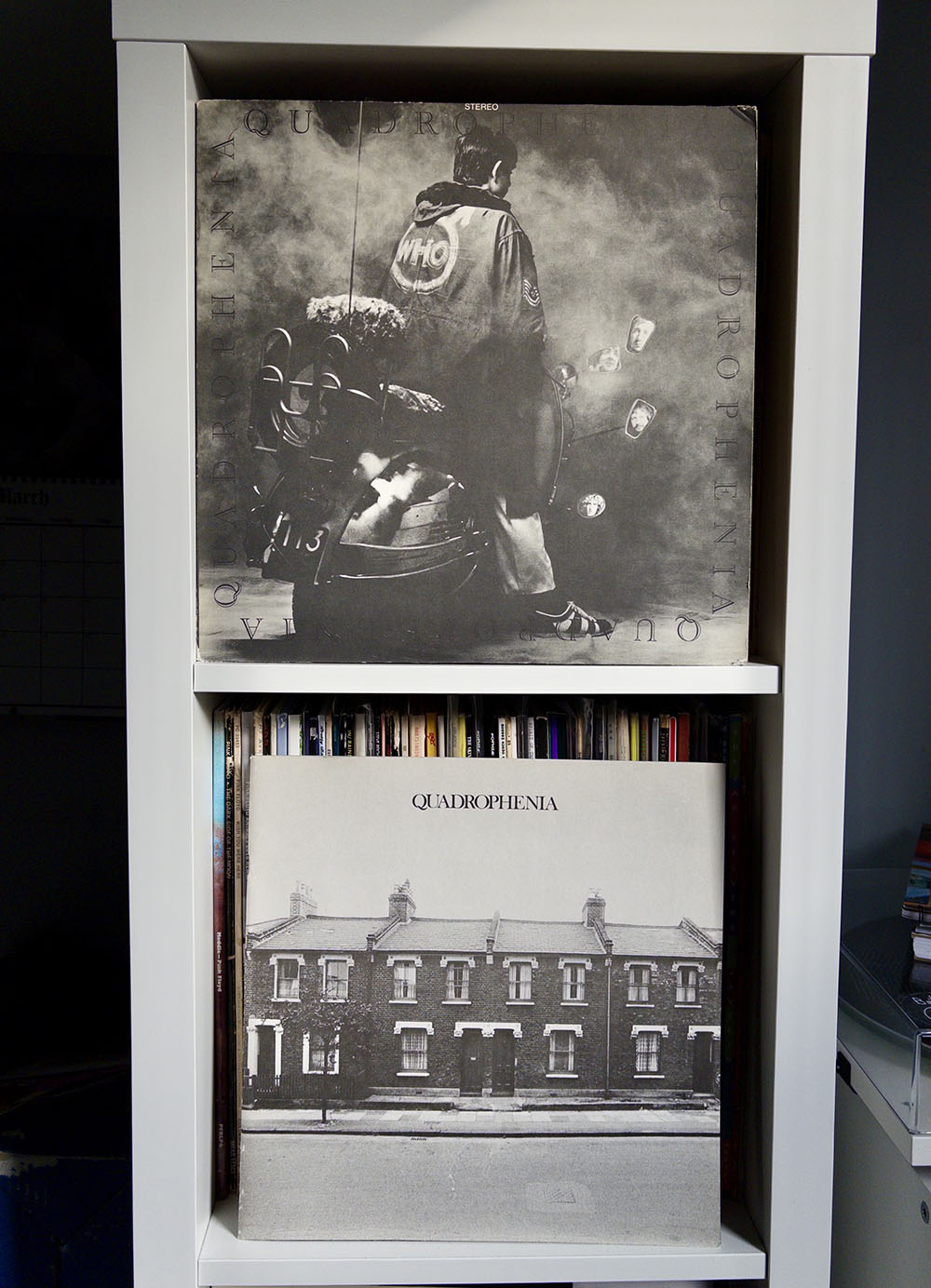
The album cover itself is a fantastic representation of identity disorder. It depicts a mod in some sort of Army jacket, back to the audience sitting on a scooter. Gazing back from each of the four mirrors are Keith, John, Roger and Pete. Keith looks a completely out there, his eyes not even looking at the camera. John’s giving a striking, confident pose and Roger is staring straight at you with his mouth just slightly open. And Pete, well… Pete is the saddest looking of the bunch. There’s a white glow in the upper right side of the mirror that drowns out his blank expression (perhaps the most fitting considering his leitmotif is the heartbreaking closing track “Love Reign O’er Me”). There was so much care put into Jimmy as an idea, and it intrigued me right from the start. Rattling around my brain are great memories of listening to “The Real Me” on the bus going to school, starting the record in the morning and timing it throughout my day so I would always land on “Love Reign O’er Me” each night just in time for a twilight bike ride. It would soon be obvious just how much I was dissociating at that time. Even trying to recall memories and events right now is very difficult, a byproduct of a complex identity disorder. It turns out I (Ceej) might not have been the one there for those experiences as a young adult. It might have been someone else. Roger whispers in my earbuds, “Is it me, for a moment?”
At this time, I’d like to take a moment and describe the concept of plurality. I’ll be pulling a lot of information from https://www.morethanone.info which is a fantastic resource on the matter. Keep in mind that my experience with plurality is purely my own, and it will be much different than how another system may operate. It’s not a concrete playbook for plurality and it shouldn’t be taken as such). While I won’t detail the exact organizational structure of my own system here, please keep in mind that going forward “we” and “I” will be used as personal pronouns and will be used interchangeably depending on how we are conveying our feelings.
At its most barebones, plurality is the concept that a single body can function as a collective, with multiple alters (sometimes called “headmates”) in a particular system taking turns with who is “at front”. Plurality is not a mental illness. It is a way to structure and cope with different kinds of identity disorders (especially DID). Alters can either be very distinct from one another or not. These differences are what make plurality so special, as often you’ll see alters who have distinct gender identities/pronouns from others, differing interests or hobbies, differing social capacities… the list goes on. A major part of plurality (for the way we operate) is how crucial it is for alters to be recognized as individuals, even when they are not at front. “Fronting” refers to whoever is piloting a particular system, though some systems can have multiple alters at front at once. Alters who exist in a system’s headspace don’t “go away” if they’re not at front, they’re still there in some capacity. There are experiences that one of my alters might’ve had that I did not, which provide specific examples of the way my identity disorder relates to Quadrophenia. I will also mention that Quadrophenia is an extremely flawed piece of media, and if you’re looking for better representations of plurality in media see Spike Jonze’s Being John Malkovich or Jane Schoenbrun’s I Saw the TV Glow.
I started identifying as a DID system sometime in 2025, though I had been struggling with identity disorders and dissociation spells my entire life. I had been diagnosed with DID at the start of college in 2018, but the crux of my mental health issues at that time revolved around anxiety and depression. My psychiatrist did not deem it necessary to medicate me for DID, something I’m very glad she didn’t. No two systems are the same and each system has a different way of organizing, processing and ensuring each member’s needs are being met. This is actually the reason I (Ceej) don’t remember much from high school. Most of my time in high school was lived through by one of my alters. I was not the one fronting and struggling, but since everyone in a system shares a body… we were all going through the worst of it.
“You got altered information / You were told to not take chances”
We felt held back by our conservative suburban environment. We were in denial, slipping into dissociative episodes constantly. There was a period of time where we would bike every night to a reservoir, talking to our soon-to-be ex-boyfriend on Skype, contemplating how we should commit suicide. If we did, we determined it would definitely be set to the first act closer “I’ve Had Enough”.
There are very few pieces of art that encapsulate the DID episodes we were prone to having in our teens than on “I’ve Had Enough”. Harsh, intrusive thoughts scowl from ear-to-ear as the chord progression moves up and up during the verses increasing the tension, only to be released by clear-minded choruses surrounded by a breath of fresh air and bongos. It shows Roger’s angry observations of Jimmy as he sees him “missing out on new dances”, which then shifts to Pete’s very gentle descriptions of what actions Jimmy could take;
“My jacket’s gonna be cut slim and checked
Maybe a touch of seersucker with an open neck”
Eventually, Keith breaks out the mallets and you get this wonderful reprieve in the form of the “Love Reign O’er Me” motif. It seems that here Jimmy’s system can take a breather. The relaxed arpeggios from the ARP 2500 crescendo to a bongo-filled chorus which contains some of my favorite lines on the entire record:
“I’ve had enough of living / I’ve had enough of dying / I’ve had enough of smiling
I’ve had enough of crying / I’ve taken all the high roads / I’ve squandered and I’ve saved
I’ve had enough of childhood / I’ve had enough of graves”
Jimmy doesn’t even realize he has an identity disorder, as the liner notes in my copy of Quadrophenia have a blurb from Jimmy’s perspective: “Schizophrenic? I’m Bleeding Quadrophenic”. He’s so close to identifying what the issue is in his life that he creates a new term, since he feels that there’s no pre-existing definition or diagnosis for how he (as a system) is feeling.
Just when you think you’re safe, Roger drops back in with another scathing verse:
“Don’t cry because you hunt them / Hurt them first they’ll love you
There’s a millionaire above you / And you’re under his suspicion”
There’s no time to self-actualize in Jimmy’s era. All the societal pressures he’s faced thus far have bubbled to the surface. The conformity he expected to escape by joining the mods has become toxic, and makes it impossible for him to work out any of his identity issues. The world around Jimmy is more interested in profit and appealing to the status quo. No wonder he’s in denial just a few songs earlier with “I’m One”. Shortly after the events of “I’ve Had Enough”, Jimmy is thrown out of his house. He now has all the time in the world to think about himself (or multiple selves). He has time to reflect on his struggles with modern life. This particular plot point feels all too familiar, as it wasn’t until we started living on our own that we had the ability to stretch our wings. To introspect. To begin to understand.
The climax of Quadrophenia is ambiguous. The LP comes with a picture booklet that shows Jimmy sitting by the sea. Flip to the next page and its the exact same photograph, with Jimmy removed from the frame. The film stays true to this ambiguity as well. We see Jimmy about to drive off a cliff, but the final shot shows just his scooter crashing off the cliff and onto the rocks. Did Jimmy jump at the last second? This is a thought that bugged my system for the longest time, that last sequence replaying in our minds like mental clockwork. We tend to forget that Jimmy is a fictional character. He never existed. He was an amalgamation of each member of The Who. He was a generalization of mod culture in England. But he was also a touchstone for our own complicated feelings about identity as a system. It turns out that you can have diametrically opposed desires. It turns out that you can feel uncomfortable in every social setting you try to fit into. It was all just a byproduct of my own identity disorder. As many issues we had with Jimmy as a main character, the same we saw in ourselves as a teenager.
Jimmy’s suicide (or at least, attempt) is set to “Love Reign O’er Me”. A song that has haunted my system for quite some time. In isolation, the track invokes a feeling that you’re out of place in this world. Jimmy is not looking for love in the conventional sense, but in a universal sense. Most of Quadrophenia’s second act is about Jimmy interacting with the public now that he’s all on his own, and the failure that comes with abandoning your “social safety net”. “Love Reign O’er Me” is a track of pure, concentrated yearning. A yearning to be understood. Quadrophenia is less about a young aimless mod trying to fit in and more about a young system looking for understanding. It’s what every queer person struggles with at some point in their lives. The feeling of being seen carries over to being a system heavily, as we are constantly seeking any acknowledgement of our plurality. I don’t think Pete Townsend set out to write a record about plurality nor do I think he or anyone at that time was equipped to participate in discussions about plurality/identity disorders as we know them today. Because of this, I don’t think The Who ever expected someone with an identity disorder to relate to Quadrophenia, as the identity disorder that Jimmy has takes a backseat to the commentary on the societal shifts in mod culture. This is one of those cases where I’m interacting with art that was never meant for me, and I am so happy that I can do that any time I throw Quadrophenia on the turntable.
The album’s opener “I Am the Sea” gives us closure in the idea that there will always be more underneath the surface. “I Am the Sea” features every alter’s leitmotif along with some fantastic field recordings of waves crashing against the shore. I can’t help but think of LCL in Neon Genesis Evangelion when listening to it, thinking of humanity reduced to primordial ooze. The sea as a metaphor for a collective of entities. Quadrophenia gave me the baseline understanding that having an identity disorder will feel isolating often. For the longest time, I had thought that I couldn’t relate to friends or family because I was an “outcast”. I felt different. Many years later I’d realize that the difficulty relating to anyone was because I wasn’t alone in my own body, and that it was all these distinct personalities struggling to take shape. In some ways, we’re still at that reservoir. Ready to jump off and plummet to our death. In reality, we’ve since left that town far behind. Any time we want to revisit it, all we have to do is throw on Quadrophenia, where we can safely relive a time in our life that was originally shrouded in confusion. Thisis a record that blessed us a fundamental understanding of how we could interface with those around us in a healthy, affirming manner. It broke down a stigma surrounding identity disorders that we couldn’t quite understand as a young adult. It breathed life into us. It made us, us.
Author Bio: Ceej Wolf (she/her) is a transgender musician and writer based in Boston. She plays drums in Perennial and performs solo as Wolfears. You can find her at https://www.linktr.ee/wolfears.