

On Peter Gabriel's "Melt" and Steve Biko
Published on Feb 21, 2026
Be Sure to Wear Flowers in Your Hair
Published on Jan 19, 2026
WALK OUT TO WINTER: falling in love with—and to—Aztec Camera's High Land, Hard Rain
Published on Dec 26, 2025
First Anniversary
Published on Dec 17, 2025
More Liner Notes…
Featured Essay: Kings of Numbers: The Police at a Fearsome Zenith
by Calum Cranberry
I have a phenomenon I call ‘The Pet Shop Boys Problem’, where the lineup of a band or artist’s best known singles never impressed me particularly. And then it clicks when I get into it, album-by-album. This could prove true of anyone, so the only way to find out is to dig in.
I remember I first listened to Synchronicity on a long train journey, around a year ago. It was one of many albums I’d preloaded for when signal wouldn’t be around, as we’ve come to expect in the UK. I anticipated something kinda smooth and janky at the same time, lyrically eccentric – probably a little monotonous despite their trademark musical diversity. I wasn’t expecting anything particularly gothic. And the only song I knew from it, as I soon confirmed, was “Every Breath You Take.”
Synchronicity mostly escapes overplay among my age group, which helps with going into it as a piece. The production is rich but light, the energy level ebbs and flows across quite a spectrum. The material, aside from being poetic, has the vital quality of Halloweenness. By close, I was surprised to find I had a new favourite album.
The Police are a controversial band, artistically speaking. There are toes I’m treading on, among people whose opinions I value, by vouching for them. They’ve heard it all before on the brilliance of the band, and are unmoved. Same for another faction if I give them a roasting. They’ve heard it all before in that direction. I’m naturally writing for both parties here.
The album has a real flow to it, which isn’t just provided by the music. It sits in a tight range between narrative work and observational declaration. Each track says something about the project by its inclusion. “O My God” speaks to an emotional space. “Miss Gradenko” tells you a story. It all comes together disquietingly.
And then there are the two title tracks. They bang! When the album opens on “Synchronicity I,” it’s straight-in with the club tempo and the Steve Reich instrumental palette. The lyrics are a volley of ideas about ideas. The tumbling vocal carries the time signature to a hummable degree. It’s quite special. Where that paints an idea, “Synchronicity II” tells a story. The inflamed spiritual ungenerosity of the man of the household overflows into the world in unexpected ways. The music hits an aggression to match.
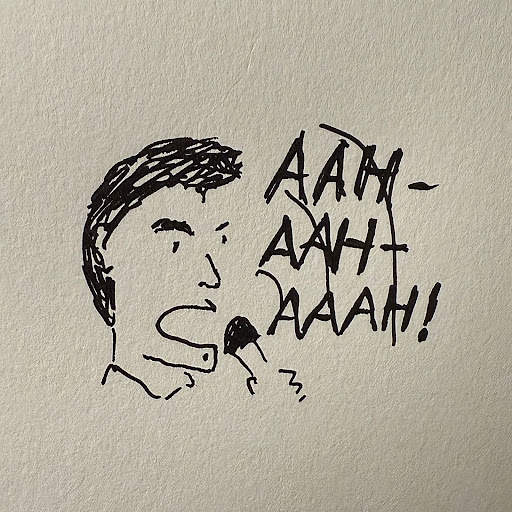
Why don’t I love, love this band? I have my moments nowadays. I wanted a song for Halloween karaoke last year, and “Synchronicity II” came to me. It’s at the top of my range, but it’s good to challenge oneself.
Artist’s impression.
Ghost in the Machine is a bit of a sister-album to Synchronicity. They’re both titled after Sting reading up on psychology, and Ghost has even more of a streak of cryptic soapboxing. It’s one I go to for the highlights (look up the lyrics to “Re-Humanise Yourself” for a smile). But part of me stays reluctant to embrace the band.
It’s October 12th and the deadline for my article on the gothic themes of The Police is coming up. I have a pot of tea on the make and too many threads to choose between. Is it working? I’m unsure. Let’s go back an album.
Zenyatta Mondatta, that’s a weird one. Only the opener “Don’t Stand So Close to Me” — another narrative song, about how there really are no takebacks when predatory thoughts become actions — entirely benefits its subject matter with the weighty production style. A lot of the humour and politics gets lost in the soupiness.
The group chose their singles well. I have several different quotes from Joni Mitchell about how she loved “De Do Do Do, De Da Da Da.” Not for the lyrics, it was her favourite to dance to when it would regularly come on at clubs in the Caribbean. Usually I’d picture their singles playing on an expensive hi-fi, but their famously complicated songs were massive international hits, and part of people’s social lives.
“When I was vacationing on St. Martin, I used to go to a little disco several times a week to dance, and I fell in love with a song by The Police, ‘De Do Do Do, De Da Da Da,’” Miss Mitchell said. “I loved the freshness of their rhythm, which was a hybrid - reggaeish but not reggae - and the way the record brought the snare drum way up into the foreground. — Joni Mitchell as quoted by Stephen Holden, New York Times.
It’s midnight now. The council tax bill sits across from me on the bookcase. Driven to Tears plays low on the turntable.
Synchronicity was certainly massive, a number one album in seven countries. And a sample size of one says it’s still making new fans. A big draw is in how it feels like the horror anthologies I’d read as a kid. Many tracks are structured to leave you with a suspicion of something that’s apt to happen after the end of the vignette. Others don’t need to be resolved, the calamity is in plain sight. Ambitious for a band who had stadiums to fill.
The Police have always had some element of the macabre. “Roxanne” is a song where the line “I wouldn’t talk down to ya…” comes in among a lengthy screed – the orator stating all his wants as imperatives. Wry, but lands the wrong way for some. It’s indeed been known to make people wonder if the band have a problem with women. Fortunately they learned their lesson, and it never came up again.
Spiritus mundi…
I’m talking past Jung here, maybe he knows what Synchronicity I says in connection to “Synchronicity II”? The tracks are named after a coinage of his: where things observed that don’t have a plausible link in their causation still strike a person as meaningful together. I’d say the sense of juxtaposition without a tangible overlap is exactly the answer, but it’s more fun to speculate beyond that for the same reason.
Past the album, another five discs of bonus material became available a couple of years back. You might like Loch, composed to fit between the Synchronicities. Your TMBG friend will love I’m Blind (demo), which sounds nothing like the album. And the pep in the initial arrangement of “Murder By Numbers” is illuminating.
At around 10am, a weary man in England finally sent out his article on The Police’s Synchronicity.
Calum has been on the other side of the bar while everyone’s celebrating, for many years now in Bristol, UK. He has finally gotten the chance to unpack his record collection, and you can critique his setup at @MyStorageBench.bsky.social