

On Peter Gabriel's "Melt" and Steve Biko
Published on Feb 21, 2026
Be Sure to Wear Flowers in Your Hair
Published on Jan 19, 2026
WALK OUT TO WINTER: falling in love with—and to—Aztec Camera's High Land, Hard Rain
Published on Dec 26, 2025
First Anniversary
Published on Dec 17, 2025
More Liner Notes…
Featured Essay: Richard Goes Sailing
by Tim Foley (aka T.J. Wolfsbane)
Despite the adoration, glorification, and wealth, members of Pink Floyd have never had it particularly easy. In the beginning, founder and lead singer/writer Syd Barrett squandered his talent, succumbing to either excessive drug use or pre-existing mental illness (or some combination thereof). Then came the burden of unanticipated commercial uber-success and all the psychological weight such things bring. Then came the creative struggles between Roger Waters and David Gilmore, the breakup that morphed into a non-breakup, the lawsuits, and the spewed, very public, hatred. To this day, Gilmore and Waters snipe at each other, revising and reinterpreting history, obscuring and disputing the past.
In 1963, Richard Wright was an architecture student who wanted to be in a band. He joined a group of guys, switched from guitar to keyboards, dropped out of school. The band called itself the Tea Set, then changed its name to Pink Floyd. If they needed him to sing, he did. If they needed him to write songs, he did. He never wanted to be the center of attention, slightly uncomfortable in the spotlight, content to contribute rather than dictate. He had a keen sense of melody and a deft ear for harmony, his influences were classical and jazz. His skills on the piano and synthesizer developed. Meanwhile, the band evolved from R&B covers to self-penned flights of psychedelic fancy and gained a following. Syd Barrett unraveled and left, the remaining band grew stronger and more successful without him. The records sold. The crowds and venues got larger, the tours longer. Wright would continue to be a secondary songwriter and vocalist, watching while Waters and Gilmore wrestled over the vision and direction of the band. And then came unimaginable success.
Dark Side of the Moon (1973) was Pink Floyd’s eighth album. It was, and is, a phenomenon, a stunningly unique piece of music, an album like no other, a pop record that is also a singular work of art. The public, all around the world, responded, buying copies of the album in numbers that the industry viewed as beyond belief given the experimental, nonconforming nature of the music involved. Not only did DSOM reach number 1 on the Billboard albums chart, it remained in the top one hundred for, essentially, a decade and a half. Wright’s musical compositions, including “The Great Gig in the Sky” and “Us and Them,” were integral to the majesty of that record.
Wish You Were Here (1975) came next, another progressive rock masterpiece, another massive seller. But a deep cynicism had crept into this tribute to the lost Barrett, and the mood was increasingly melancholy and depressed. Success, it seemed, does not lead to happiness and contentment, but to angst and madness. And the band began to splinter.
Wright bought property in Lindos, a village on the island of Rhodes in Greece, and spent much of his time sailing. The world tours had become mammoth enterprises that only giant arenas could hold, and he would escape to Greece whenever he could, growing less and less interested in the commercial monster called Pink Floyd. Roger Waters had essentially taken over the band, and Animals (1977) reflected that reality. Wright did his duty, playing on the recordings and slogging through the tours, but his creative input was minimal.
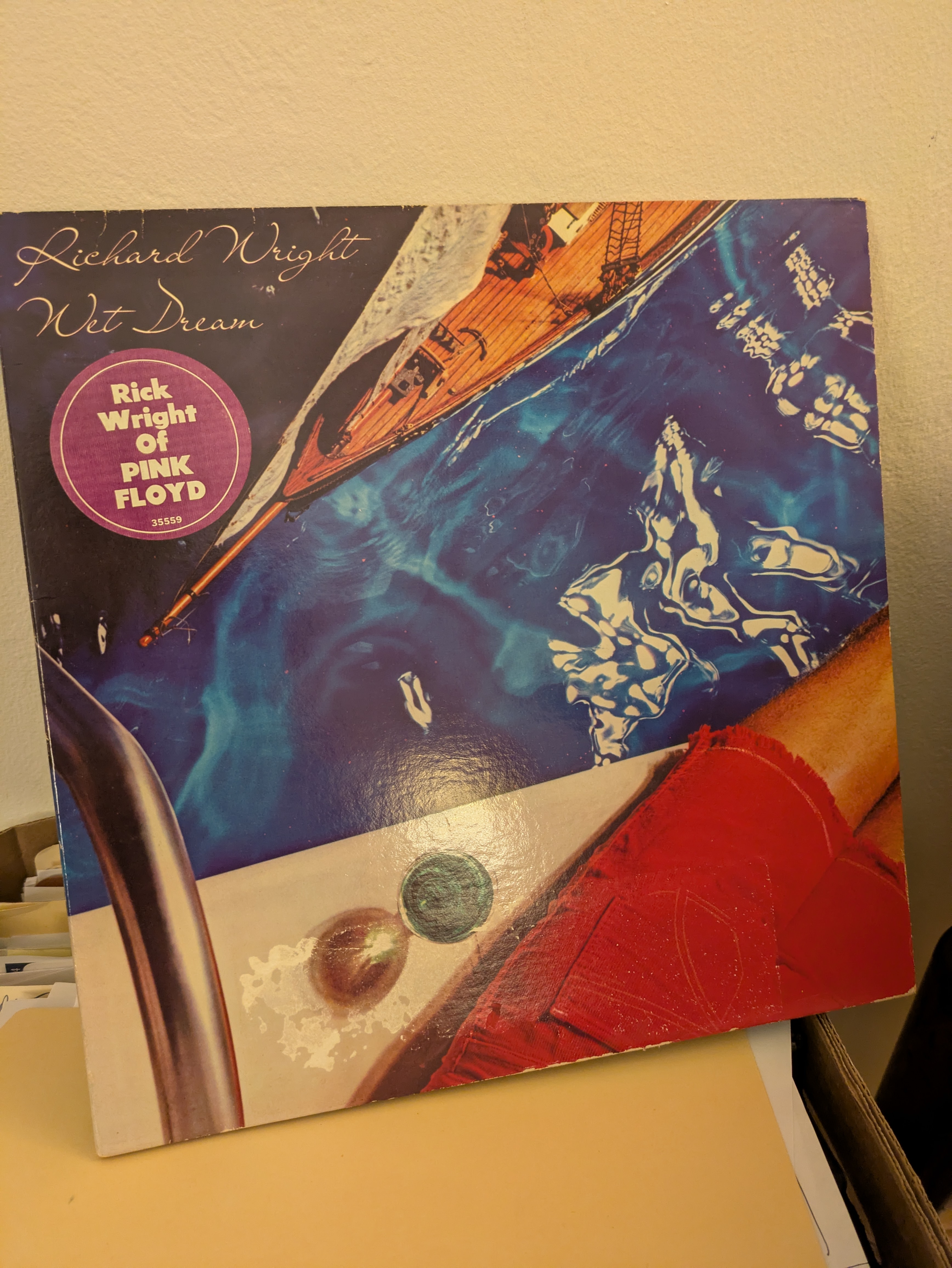
Which brings us to Wet Dream, Wright’s elegant, beautiful, and terribly underrated solo album. By 1978, Wright was no longer meaningfully contributing to Pink Floyd, and he spent January and part of February in a studio in southern France, recording quiet songs about sailing the waves, swimming the seas, and searching for life’s meaning. He produced the record himself, wrote virtually all the songs – his wife Juliette contributed some lyrics – and invited non-Floydian friends from England to come play. Snowy White (guitar), Mel Collins (sax), Larry Steele (bass), and Reg Isadore (drums) made up the band. Hipgnosis did the cover. In September, the record was released on Columbia, who slapped a sticker on the front to alert folks that Richard Wright was also “Rick Wright of Pink Floyd” and did little to promote the album other than sending it to a few college radio stations. It pretty much went unnoticed and unheard.
The first track on the second side is called “Holiday,” and it wonderfully echoes the sweet qualities of Meddle-era Floyd. Wright sings in that calm, enchanting voice: “Between these lines, I know you see a man who’s not quite sure who he is or where he stands,” asking us to accompany him on his sailing excursions to the Mediterranean, to leave behind all that chaos and anxiety. This obscure, engaging song is a personal favorite, and the theme is consistent with the other tracks on the album. Roughly half are instrumentals, subtle and wonderfully produced, some with jazz influences that were no doubt suppressed in the prog-rock cloud of Wright’s main band. One tune, titled “Pink’s Song,” seems like an extra track from Wish You Were Here, the lyrics calling to mind the mythical exit of Wright’s old flat-mate, Syd Barrett.
Wet Dream disappeared soon after its release. Many Pink Floyd fanatics express surprise to learn that Richard Wright released a solo record in the 70’s. The album finally received a proper CD remix/rerelease in 2023, but there is a sharpness to that production such that I strongly prefer the original vinyl. The debate goes on regarding the merits of solo records released by Pink Floyd members, and that debate tends to fall into a familiar Gilmore versus Waters pattern. But, believe me, that old keyboard player really did matter, and Mr. Wright’s record is the one that should be on the turntable.
Tim Foley is a writer and playwright, living in Sacramento. His collection of ghost stories, Tales Nocturnal, was issued by PS Publishing in 2025. Long ago, he played guitar for a few Bay Area bands and, even longer ago, he was the music director of an FM radio station. His website: www.TimothyJFoley.com