
On Peter Gabriel's "Melt" and Steve Biko
Published on Feb 21, 2026
Be Sure to Wear Flowers in Your Hair
Published on Jan 19, 2026
WALK OUT TO WINTER: falling in love with—and to—Aztec Camera's High Land, Hard Rain
Published on Dec 26, 2025
First Anniversary
Published on Dec 17, 2025
More Liner Notes…
Featured Essay: Skating on Records: Bob Marley or Bon Jovi?
by Krystal Sital
It’s 1991. Or ’92. Possibly ’93. And I’m 4 or 5 or 6 years old. Point is, I’m young. And for the record (pun intended), dumb.
My father loves music but maybe more than the music itself, he loves the ritual of slipping a disc out of its jacket, blowing delicately on it to rid it of dust particles before placing it tenderly on the player. I see the love with which he moves the needle to the grooves, hear the familiar crackling and popping before melodic tunes fill the air around us. His face melts into serenity and he belts out the words with gusto, sometimes, dancing. He loves what he loves unabashedly and I absorb this from him without realizing it.
He’s a policeman and therefore keeps stringent hours—he wakes at 4am, leaves by five and comes home for dinner like clockwork. When he leaves for work, I’m at home with my mom who, depending on the year between 1991-1993 was pregnant, had just given birth, or was nursing a baby in addition to taking care of me.
Because I grew up in Trinidad and Tobago, we had concrete floors. If you’re lucky like me, they’re nice and smooth. There was this hallway we had that ran the length of the second floor from front to back. Left to my own devices one day, I slipped a record out of its sleeve, gave it a gentle toss like I was throwing a frisbee, ran and leaped onto it, careening down the corridor, hair flying up behind me, arms spread wide. The feeling was exhilarating. And addictive.
So I decide to try two instead.
Two records—one beneath each foot—gave me more adventure. I moved faster, each foot independent of the other. I could swerve, push against the walls and make a zigzag pattern, ping ponging from one side of the narrow hallway to the other.
I don’t notice the shiny luster of the black vinyls turn cloudy with scratches. But I do notice how many he has shelved neatly like books so I pull out piles of records and bellyflopped onto them, squealing as I skate down the hallway like it’s a waterslide. At the end of my fun, I put them all back.
One night my dad realizes something is wrong when one record after another starts skipping. He attempts to rub the shine back into them, no doubt in shock. He moves from one to the other frenetically, comprehension dawning on his face as he turns to me.
I confess easily, not understanding why these records can’t have a dual purpose: they could bring us both joy, just in different ways. I promise I would never do that again and that story somewhere over the years, thankfully, becomes anecdotal.
Fast forward 34, 35, 36 years to now in a different country—America.
Now I’m a parent of three children. We can’t survive without music every single day. Speakers are in almost every room, we all have access to apps that save our own playlists; when we get tired of each other’s music, we sequester ourselves in a room to listen, alone.
Until: a friend gifts us a record player.
I’m adamant that I don’t want it. We don’t need another thing taking up space and collecting dust. But my husband does want it. Having not grown up with one, he’s intrigued. He’s also a programmer so I know he wants to watch it work, fiddle with it and if I let him, he’d take everything apart just to see if he could put it back together again.
Enter: the record player.
We unbox it together as a family. My children bombard me with questions. And it’s then I realize that while this is familiar to me, it is unfamiliar to every other person in my house. Naturally, they’re all curious.
“We live in an age where music is so readily available. We have it right here. It’s portable. I can play you anything you want right now. Look.”
And I go to play a song but everyone’s attention is fixated on the record player.
“Guys, it’s not that interesting. It’ll probably sound so old. And who even buys records anymore?” I continue, desperately wanting to regift this to someone else.
“Actually, vinyl sales have been on the rise. Popular artists have them available. They even sell more than CDs,” my husband says as he unsheathes a record from an envelope (said friend also unloaded a bunch of records along with the player).
“What? Really? How do you know this?” I question skeptically.
Upon immediate further investigation, I learn he’s right. And the closer he gets to playing the disc, the more I realize that I’m looking forward to it. This object holds with it nostalgia and with that memories from my childhood and now they’re all bubbling to the surface. When taken at just the right dose, the power of nostalgia is intoxicating.
My husband holds the vinyl carelessly and ironically I’m the one to gingerly take it from him, and caution him and my children on how to handle them carefully before placing it onto the turntable. We all gather around to watch the needle move and position itself over the groove and start playing. We wait, our breath caught in our chests.
It begins after a wistful scratchy sound and in an instant I’m in a battle with mesmerization. I find myself saying words out loud I want to stuff right back in my mouth.
“Why does it sound so good?” I ask.
They think I’m talking about the music but I have no idea who is singing or what they’re saying. It’s the sound.
“That can’t be right. Did they remaster this track?” I clarify.
I watch him check and then I check myself. The answer is no, they did not.
“Am I hearing things? Why does this sound so good?”
What I’m in utter disbelief over is the richness of sound spilling over us. The depth that fills our room right now. I step out of the room and it follows me, the vibrations all around us.
“Okay, we’re going to run an experiment right now,” I say.
We find the same song on my phone that’s on the record player. We hook them up to identical speakers with the same settings and then we close our eyes.
“Okay, play one but don’t tell me which and then play the other,” I tell my husband.
I can immediately tell which is playing. We all can. Songs from my phone fall flat in comparison to the robust melodies emitting from the record player.
“You like it,” he teases.
“I don’t want to. Fine, yes but why? Why? Why do I like it? Why does it sound better? Why?”
I’m out of my element certain technological advancement in music would have enhanced music to the point a record player could never be competition. But I am woefully wrong.
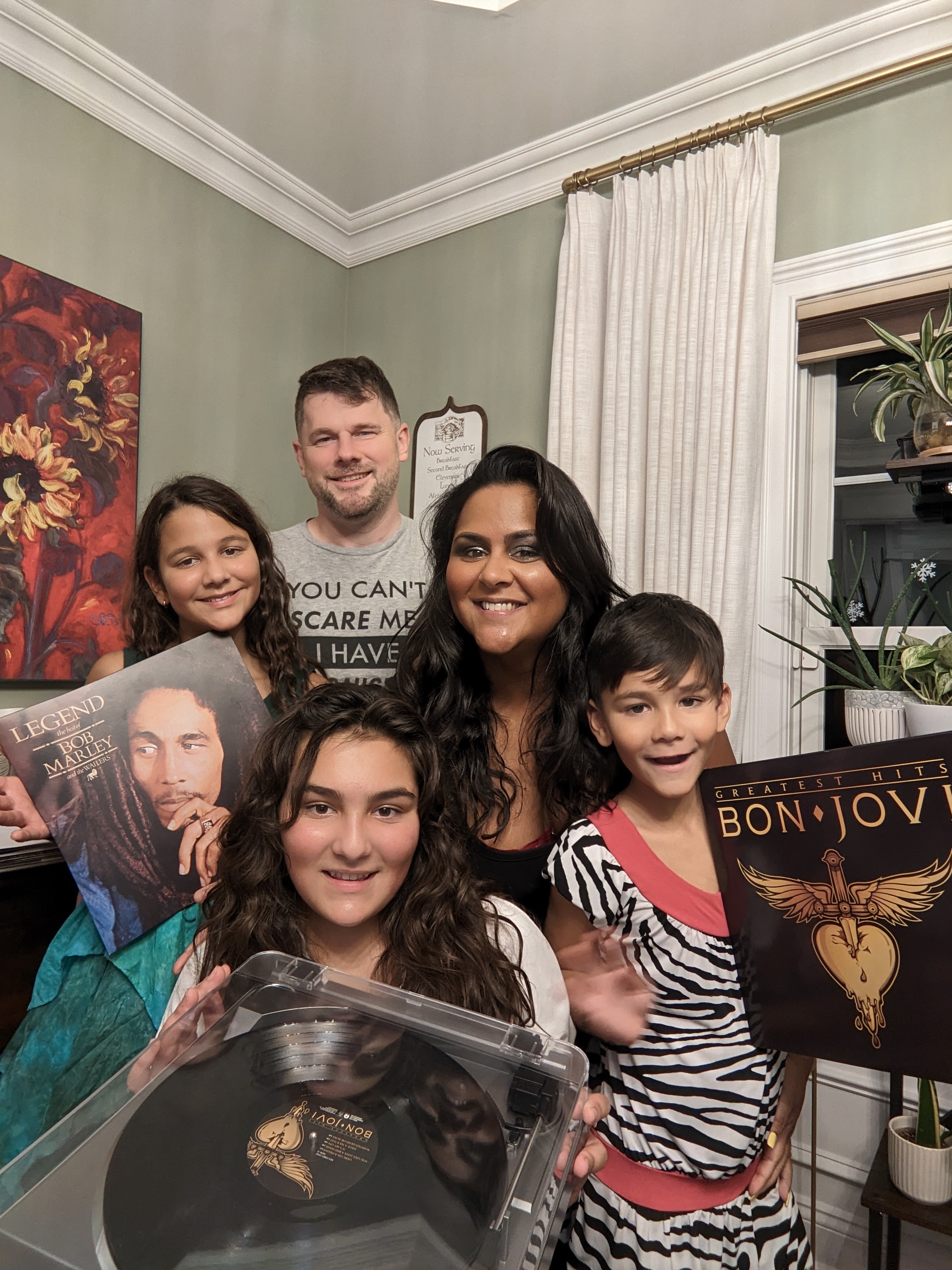
I purchase one record after another and as a family we gather together to listen to music as we always do except that it’s different. Now, it’s intentional and rather than music in the background, it exists alongside us, a part of the conversation.
I slip a disc into place one day, so excited, I’m jumping up and down. The familiar songs unfold like a story and I sing along to every word. I look around me when no one joins in. They don’t know the words.
“Wait, you don’t know this song?” I ask.
They all shake their heads. I’m so flabbergasted I clutch my chest.
“What have I done so terribly wrong that you don’t know this song. You do know who this is, don’t you?”
My children shake their heads again.
“Children, it’s Bob Marley!”
They continue to look confused.
“Oh, oh, oh, it’s that guy who sings about the diner and Tommy and Gina?” one of them asks helpfully.
“What?” I roar. “No, that’s Bon Jovi!” (To be fair we live in New Jersey and of course we have his vinyls, too).
“Oh, I don’t think I like him very much,” my oldest declares.
“Get out,” I say, pointing to the back door.
They all freeze for a second before collapsing into laughter repeating over and over again, “Mommy told her to get out because she doesn’t know who Bob Marley is.” They reiterate this line to the point it becomes an incantation in the ensuing weeks and I know, like my own anecdotal-record-skating story, it’s one they’ll repeat for a lifetime.
As I cook and sing and listen about their day, I tell them the story of me skating on their grandfather’s records.
“Can we do that?” one of them pipes up way too excited at the prospect.
I cringe, thinking about my records being ruined on our floors.
“But your floors were concrete. We have wooden floors. It can’t be that bad,” one of them says reasonably.
“That was a cautionary tale not a prescriptive one,” I clarify, laughing. “Do I need to lock them away from you?”
They shake their heads, one of them ruefully pointing to the special vinyl brush I am now in possession of solely meant for ridding my records of dust particles.
Now when we use our record player it’s with such purpose but above all, love. For when we do it, it’s with the intention of converging. Music becomes stories, becomes family, the most powerful thing in the world.
Krystal A. Sital is the author of the critically acclaimed memoir Secrets We Kept: Three Women of Trinidad which was a finalist for the PEN America Emerging Writers Award. Her essays have been anthologized in A Map Is Only One Story and Fury.Krystal’s work has been featured in The New York Times, ELLE, HuffPost, Today’s Parent, Salon, Catapult, LitHub, The Margins, and elsewhere. She currently teaches nonfiction at the University of Reno in Tahoe’s low residency MFA program.