
On Peter Gabriel's "Melt" and Steve Biko
Published on Feb 21, 2026
Be Sure to Wear Flowers in Your Hair
Published on Jan 19, 2026
WALK OUT TO WINTER: falling in love with—and to—Aztec Camera's High Land, Hard Rain
Published on Dec 26, 2025
First Anniversary
Published on Dec 17, 2025
More Liner Notes…
Featured Essay: The Best Cut Is The Deepest – In Praise of Record Compilations
by Adam Steiner
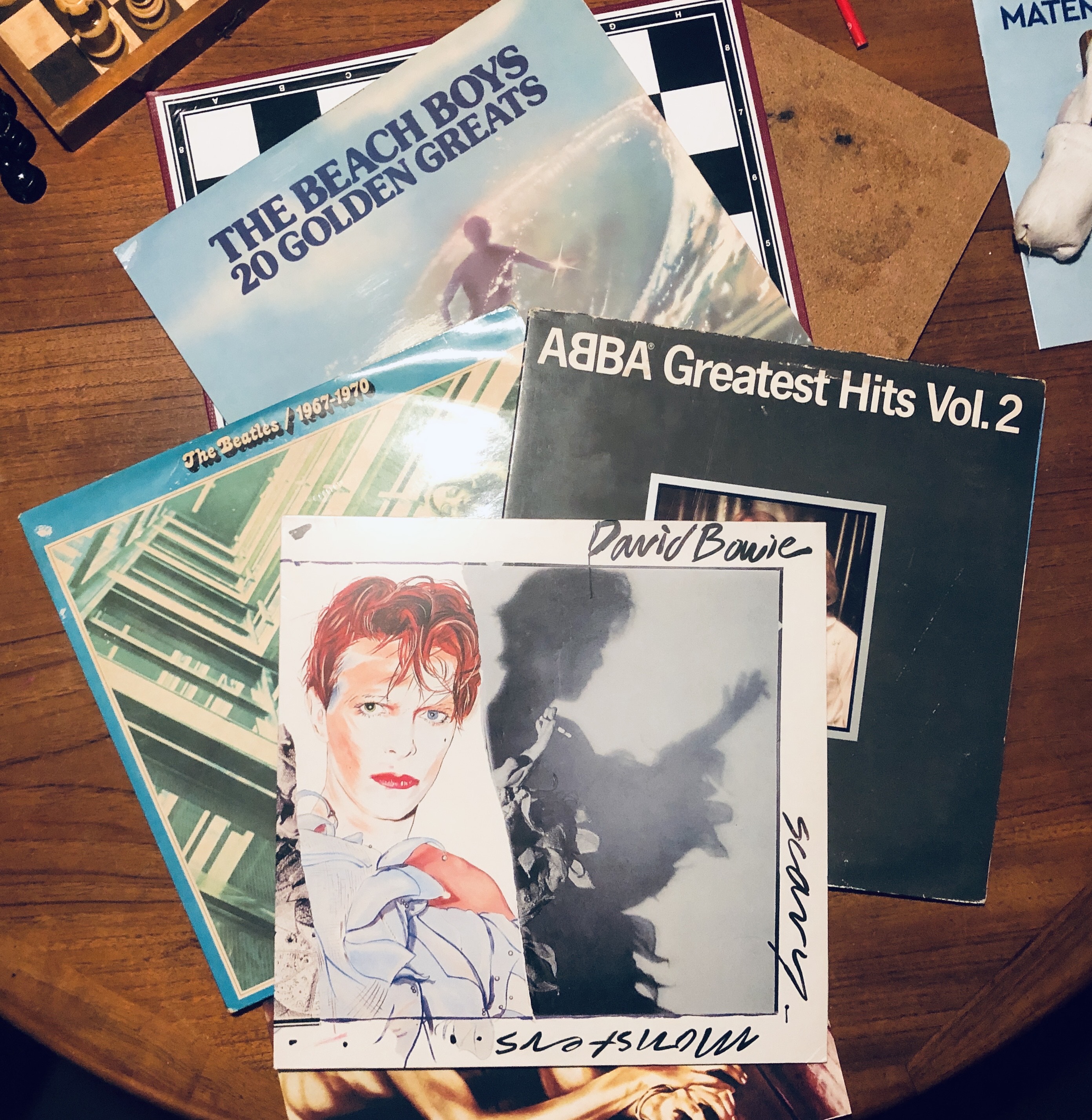
For every band’s best or most popular album, there is a compilation that stands far above it, if not, as its equal. Whether it’s a traditional Best-Of, singles collection, oddities or even a fan-made bootleg, these sometimes random selections can better express a band’s unique character; marking their key development or artistic peaks, better than the most skipless record, trimming the fat of filler tracks and going straight to the heavy stuff.
I love Best-Ofs, the single-heavy record of choice for new listeners, casual fans and those people who only listen to the radio because they like “all kinds of music” – there is literally something for everyone. Best-Ofs are easily maligned, neglected even, by full discography purists. But for so many of us, our first listen to bands of a certain vintage are Best-Ofs. First heard as a teenager, they remain our most immediate and therefore memorable experience of a band–informing and shaping our musical tastes and perspective into adulthood.
For me, it was The Clash’s 1999 live album, From Here To Eternity, bought on cassette in a supermarket bargain bin, breezes through many of their greatest singles and strongest album tracked–all beefed-up in front of stadium audiences. Equally, The London Years three-disc compilation of early Rolling Stones is perhaps the only record you’ll ever need by them, yet it doesn’t even get as far as 1971’s Sticky Fingers (my favourite).
I argue the Best-Of can express what makes a band most unique, allowing us a confrontation with the span of their history and a gateway through to their wider discography. I would go further and state that some pop bands are perhaps best defined by such compilations. Take ABBA, (the last-ditch greatness of the final album, The Visitors notwithstanding) they are best experienced on the two Best-Of compilations, packed with floor-fillers, intimately recognisable to all, great at parties.
High-minded critics will sneer at the sheer populism of a broad compilation which celebrates a band’s most accessible and radio-friendly moments. They have a point. Best-Ofs often lack the deep-cut credibility of a ‘full’ album—and neglecting the self-contained whole of an album, recorded as a piece, and evoking key periods within an artist’s evolution. I love the consistency of The Cure’s, Staring At The Sea singles collection, but I would never trade it for Pornography (1982) or Disintegration (1991).
Consider Alan Partridge, the everyman of Middle-England mainstream malaise, who once notoriously cites “The Best of The Beatles“ as his favourite record by the band. Unwitting as ever, Alan opens himself up to ridicule by choosing the most generic musical format–but he has a point. Perversely, The Beatles were defined by their single releases, including several non-album wonders, such as the Double-A side of ‘Strawberry Fields Forever’ and ‘Penny Lane’, while at the same time, helping to kill-off The Sixties reliance on the single, by affirming the unified album as the dominant format of the late 20th century. This soaring achievement is encapsulated by the 1 album, collecting together their 27 number one singles. Equally, the Red and Blue compilations, respectively bookend the early and later years of a decade-long recording career into two distinctive phases. The ‘Blue Album’ in particular embeds ‘the other two’ consistently overlooked contributions, such as George Harrison’s ‘Old Brown Shoe’.
Consider PiL (Public Image Limited) and their Second Issue / Metal Box album, the most iconic PiL record, dubby, harsh, spartan, but equally imbued with a haunting atmosphere and its freakish time signatures and melodies. But PiL have had ‘hits’, their first single ‘Public Image’, ‘Rise’ ‘The Order of Death’ and ‘This Is Not A Love Song’, enough music to make two ‘Best-Ofs’ – Greatest Hits, So Far (1990) and This Is PiL (2012). These relatively pop-shiny compilations stand in stark contrast to their overall output and are forced to overlook some records. For example, the brutal polyrhythms and chanted rants of 1981’s Flowers Of Romance, recorded when bassist Jah Wobble had quit and guitarist Keith Levene was on the way out due to heroin addiction, leading to an album dominated by drums, effects and John Lydon chants – mesmeric and exhausting in equal measure – a flawed masterpiece.
Certain other bands absolutely shine in the compilation format. Despite five brilliantly balanced and sequenced studio albums, The Smiths are a rare beast where many of the B-sides (‘Girl Afraid’) are as good as the A-sides (‘Still Ill’). The output quality is so high that the grab-bag, Hatful Of Hollow, made up of punchy BBC live sessions and the feral deep cut of ‘How Soon Is Now’ can stand alone. This song is later tacked on to reissues of Meat Is Murder – making that album almost too rich for my blood.
By contrast, Nine Inch Nails, despite several fan compilations and a failed 2013 attempt at a Best-Of by Trent Reznor’s then record label, are more or less resistant to a ‘greatest hits’. His albums begin to make less sense with key tracks heard in isolation; although this is the nature of live performances, the recent Peel It Back tour was brilliantly arranged with a variety of tracks from across several NIN-eras. Nonetheless, Nine Inch Nails are successful primarily because of their consistent album output, not hit standalone singles.
Equally, there are fantastical compilation outliers, some of my favourite Bowie records that I own are BOWIECHANGESONE and BOWIECHANGESTWO (easy to find on vinyl for a mere £10). An idiosyncratic mix of key singles from his golden 1970-1980 decade, alongside key album tracks, easily overlooked – ‘Word On A Wing’ and ‘1984’, In the same vein, there is the excellent 1980 ALL CLEAR (1979), a US-only radio sampler which shows off deep-cut highlights including ‘Fascination’ and ‘Always Crashing In The Same Car’, laying the groundwork ahead of his 1980 album release, Scary Monsters (And Super Creeps).
Perhaps the Best-Of remains a necessary evil, certainly for new generations of listeners, we ignore them at out peril, and through them the future of new listeners to past music is assured.
Adam Steiner is the author of Silhouettes And Shadows: The Secret History of David Bowie’s Scary Monsters (And Super Creeps), as well as books on Nick Cave and Nine Inch Nails–The Downward Spiral.
Twitter - @BurndtOutWard
IG - @AdamSteinerAuthor